 |
|
Несколько раз я планировала поездку в Тарусу, но всё почему-то откладывалось, хотя для меня это путешествие не в самые далёкие края ― от Москвы на машине ехать не более двух часов. Прекрасный выбор для тура выходного дня. Да и переночевать в этом городе тоже есть где, тем более что это довольно популярное туристическое направление. В 2026 году Тарусе исполнилось 780 лет (с даты первого упоминания в летописи) ― серьёзный возраст для маленького городка. Я думаю, тут поселение гораздо старше, учитывая, что оно организовалось на стыке двух рек ― Оки и Тарусы. По последней город и получил своё наименование. Историческая наука считает, что сначала это было место обитания балтов, потом пришли славяне и ассимилировали их. На территории города учтено 14 археологических памятников, датируемых от эпохи палеолита до позднего средневековья (источник). Есть легенда, что город в этом месте существовал ещё в 964 году, но подтвердить этот факт сейчас невозможно. И если уж придерживаться фактов, то время возникновения города Тарусы достоверно неизвестно (источник). Как справедливо пишет Википедия, Таруса сохранила свой уникальный облик, сформированный ещё в 19 веке. Большинство зданий не выше двух этажей, сейчас это настоящий природно-архитектурный заповедник. Город расположен в довольно живописном месте, на высоком (левом) берегу Оки, в устье реки Тарусы, где Ока образует плавную излучину, тем самым создавая естественный природный амфитеатр. Из-за низкой застройки город утопает в деревьях. С одной стороны, именно поэтому этот городок хочется назвать деревней. С другой стороны, мы уже настолько отвыкли от настоящей России со всеми этими многочисленными человейниками в мегаполисах, что уже начинаешь забывать, как должен выглядеть «город здорового человека» в самой большой стране мира, где очень много территории. Административно город относится к Калужской области, но правый берег Оки, прекрасно обозреваемый с высот левого берега ― это уже Тульская область. Когда-то оба берега были соединены плашкоутным мостом, но во время войны в 1942 году его демонтировали советские войска при отступлении (это была стандартная военная практика тех лет). Прямого железнодорожного сообщения у Тарусы нет, регулярного речного транспорта здесь тоже нет. Добраться до города можно только автомобильным транспортом. И, надо сказать, что народная (автомобильная) тропа сюда, видимо, ещё долго не зарастёт, что на самом деле совсем не удивляет, стоит хотя бы чуть-чуть познакомиться с этим местечком. Не люблю повторять открытые источники, в Интернете о Тарусе можно много что почитать/посмотреть. Здесь я хочу поделиться своим собственным впечатлением о городе, который для меня лично оставил после себя довольно странное впечатление: здесь русскому человеку можно наконец-то почувствовать себя дома (как бы странно это ни звучало). Особенно интересно посещение этого города москвичу, который уже давно стал чужим в родном городе. Здесь всё просто: улицы широкие, тротуары нормальные, автомобилю есть где припарковаться (сразу видно уважение к транспорту, который связывает этот город с остальным миром). Народу не очень много, хотя по статистике население города ― чуть менее 10 тысяч человек (в пик сезона с наплывом дачников и туристов людей становится больше). Из-за того, что в городе запрещена высотная застройка (разрешено строить дома не более трёх этажей), город плавно растёкся вдоль Оки, и народу на улицах поэтому тоже не очень много (мы были в будние дни, и то половина встретившихся нам людей ― туристы). В советские времена Таруса находилась за пресловутым «101-ым километром» ― это область, за которую из столицы СССР высылали всех неугодных. Благодаря чему во второй половине 20 века город стал знаменит своей интеллектуальной «тусовкой», о которой, правда, я тоже не хочу сильно распространяться, поскольку имею несколько иные литературно-художественные предпочтения. Мне интересна Таруса сама по себе. Несмотря на то, что город на первый взгляд кажется обычной замшелой провинцией, всё-таки это не совсем обычная русская провинция. Здесь будет хорошо прежде всего тем, кому не нужна городская суета и хочется, наоборот, тишины, покоя и творческого отдохновения. Для меня главная достопримечательность в этом городе ― это Ока. Я вообще люблю реки, но не большие (и страшные), а как раз небольшие, тихие и уютные, которые умиротворяют и дарят чувство необыкновенного единения с природой, когда на тихом берегу можно посидеть и посозерцать медленное течение облаков в отражении речной поверхности. Ока ― главный создатель уникальной и неповторимой Атмосферы города, ради которой сюда и едут. Хотя, конечно же, не будем списывать со счетов необычайно живописную речку Тарусу, изображённую на гербе города, но эта река спрятана среди высоких деревьев и подступы к ней не очень просты. Таруса ― это приятное обжитое пространство, которое ничего от тебя не просит и ничего тебе не навязывает. Тут очень тихо, потому что нет крупной промышленности. Тут очень спокойно, потому что тут никто никому ничего не должен. Этот город создан для людей и существует он тоже именно для них. Это действительно приятное пространство, в котором чувствуется настоящая свобода от мишуры «городской жизни», как это обычно бывает в крупных городах. Мне кажется, что именно такой и должна быть настоящая Россия.
* * *
Several times I planned a trip to Tarusa, but for some reason it kept being postponed, although for me this journey is not to the most distant parts — from Moscow by car it takes no more than two hours. A wonderful choice for a weekend tour. And there is also somewhere to stay overnight in this town, especially since it is a fairly popular tourist destination. In 2026, Tarusa turned 780 years old (from the date of its first mention in the chronicle) — a serious age for a small town. I think the settlement here is much older, considering that it formed at the junction of two rivers — the Oka and the Tarusa. It was after the latter that the town received its name. Historical science believes that at first this was a place of habitation of the Balts, then the Slavs came and assimilated them. On the territory of the town, 14 archaeological monuments have been recorded, dating from the Paleolithic era to the late Middle Ages (source). There is a legend that a town existed in this place as early as 964, but it is currently impossible to confirm this fact. And if we stick to facts, the time of the emergence of the town of Tarusa is not reliably known (source). As Wikipedia rightly writes, Tarusa has preserved its unique appearance, formed back in the 19th century. Most buildings are no higher than two storeys; today it is a genuine natural and architectural reserve. The town is located in a rather picturesque place, on the high (left) bank of the Oka, at the mouth of the Tarusa River, where the Oka forms a gentle bend, thereby creating a natural amphitheatre. Due to the low-rise buildings, the town is immersed in trees. On the one hand, this is precisely why one wants to call this small town a village. On the other hand, we have already become so unaccustomed to the real Russia with all these numerous "human anthills" in megacities that one begins to forget what a "city of a healthy person" should look like in the largest country in the world, where there is a lot of territory. Administratively, the town belongs to Kaluga Oblast, but the right bank of the Oka, perfectly visible from the heights of the left bank, is already Tula Oblast. Once both banks were connected by a pontoon bridge, but during the war in 1942 it was dismantled by Soviet troops during their retreat (this was standard military practice of those years). Tarusa has no direct railway connection, and there is no regular river transport here either. One can reach the town only by automobile transport. And, it must be said, that the people's (automobile) path here, apparently, will not become overgrown for a long time, which is actually not at all surprising, if only one gets to know this place at least a little. I don't like repeating open sources; there is a lot one can read/view about Tarusa on the Internet. Here I want to share my own impression of the town, which personally left me with a rather strange impression: here a Russian person can finally feel at home (however strange it may sound). It is especially interesting for a Muscovite, who has long become a stranger in his native city, to visit this town. Here everything is simple: the streets are wide, the sidewalks are normal, a car has somewhere to park (one can immediately see respect for the transport that connects this town with the rest of the world). There are not very many people, although according to statistics the population of the town is slightly less than 10 thousand people (at the peak of the season, with the influx of dacha owners and tourists, there are more people). Due to the fact that high-rise construction is prohibited in the town (it is allowed to build houses of no more than three storeys), the town has smoothly spread along the Oka, and therefore there are also not very many people on the streets (we were there on weekdays, and even then half of the people we met were tourists). In Soviet times, Tarusa was located beyond the notorious “101st kilometre” — an area beyond which all undesirables were exiled from the capital of the USSR. Thanks to this, in the second half of the 20th century the town became famous for its intellectual “gathering”, about which, however, I also do not want to dwell too much, since I have somewhat different literary and artistic preferences. I am interested in Tarusa itself. Despite the fact that at first glance the town seems to be an ordinary moss-grown province, it is still not quite an ordinary Russian province. Here it will be good primarily for those who do not need city bustle and who want, on the contrary, silence, peace and creative respite. For me, the main attraction in this town is the Oka. I generally love rivers, but not big (and scary) ones, but rather small, quiet and cozy ones, which soothe and give a feeling of extraordinary unity with nature, when on a quiet bank one can sit and contemplate the slow movement of clouds in the reflection of the river surface. The Oka is the main creator of the unique and inimitable Atmosphere of the town, for the sake of which people come here. Although, of course, let us not discount the extraordinarily picturesque Tarusa River, depicted on the town's coat of arms, but this river is hidden among tall trees and the approaches to it are not very easy. Tarusa is a pleasant, lived-in space that asks nothing of you and imposes nothing on you. It is very quiet here because there is no large-scale industry. It is very calm here because here no one owes anything to anyone. This town is created for people and it also exists precisely for them. This is indeed a pleasant space in which one feels genuine freedom from the tinsel of "city life", as is usually the case in large cities. It seems to me that this is exactly what the real Russia should be like.
2026
|
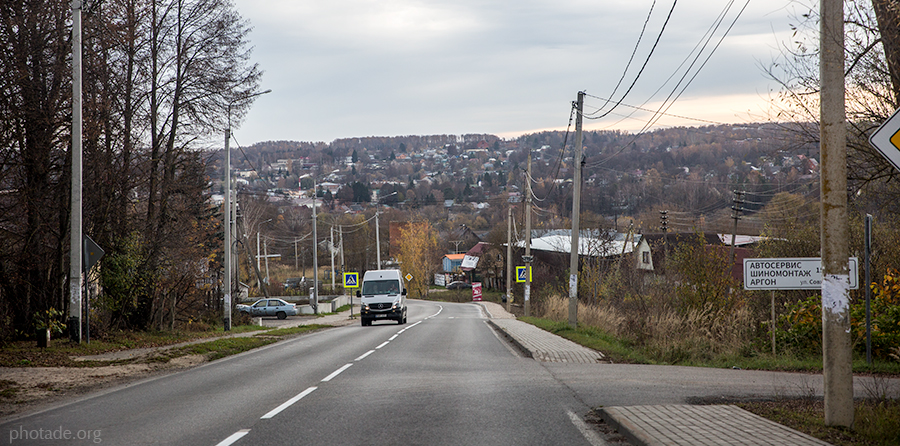 1. Город расположен на холмах, поэтому при въезде в историческую часть тебя встречают панорамные виды. The town is located on hills, so when entering the historical part of the town, you are greeted by panoramic views. |
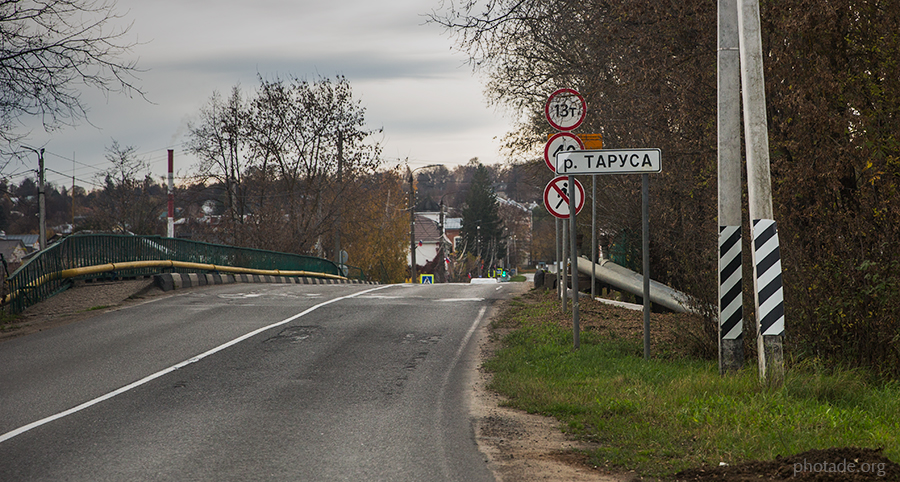 2. Своё название город получил по названию реки Таруса, которая впадает в реку Оку, и об этих реках мы поговорим в отдельных галереях. The town received its name from the name of the Tarusa River, which flows into the Oka River, and we will talk about these rivers in separate galleries. |
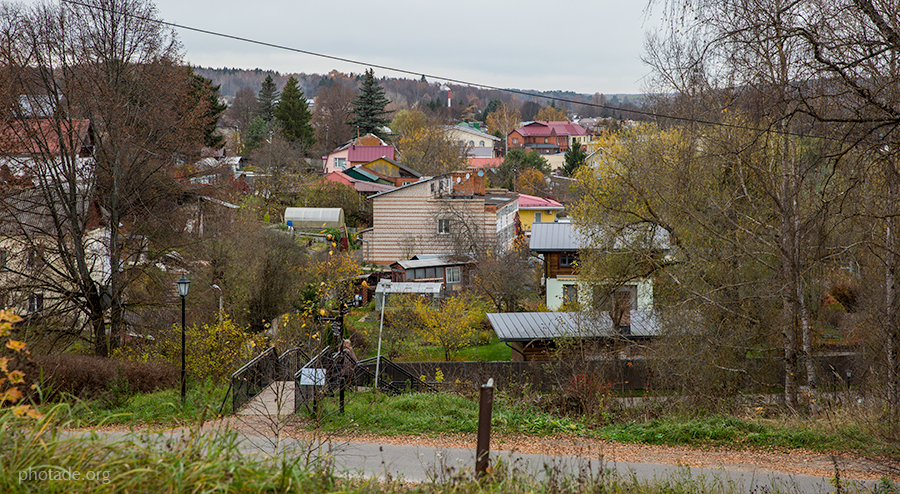 3. Типичная застройка. Среди стареньких домишек традиционной русской архитектуры попадаются и современные домики различной степени привлекательности. При этом каждый строит кто во что горазд, видно, что власти города не заставляют жителей придерживаться какой-то конкретной архитектурной концепции. Из-за чего город выглядит, мягко скажем, немного эклектично. Typical development. Among the old little houses of traditional Russian architecture, there are also modern little houses of varying degrees of attractiveness. At the same time, everyone builds however they like; it is visible that the town authorities do not force residents to adhere to any specific architectural concept. Because of this, the town looks, to put it mildly, a little eclectic. |
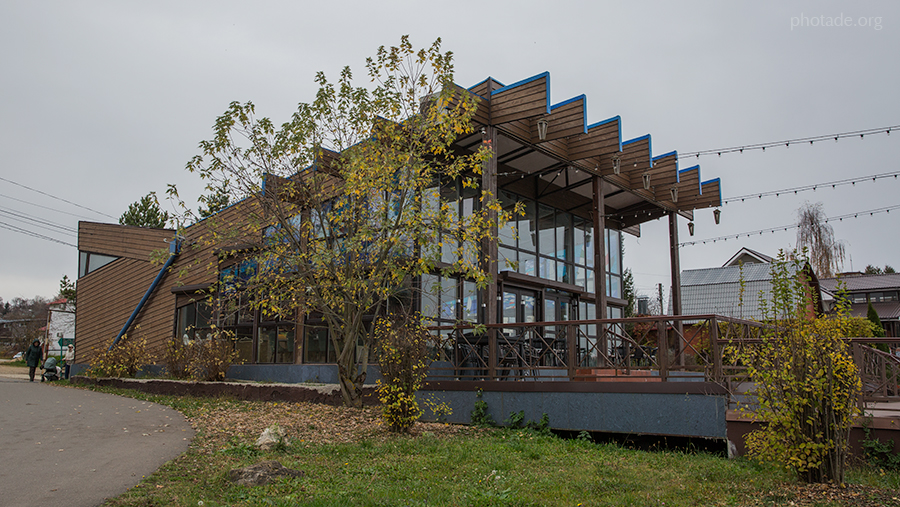 4. Кафе «Сети» с прекрасным панорамным видом на Оку. Не единственное подобное заведение в городе, хотя октябрь ― это не то время, когда хочется посидеть на веранде с чашечкой кофе. Но кухня весьма достойная. Со стороны кафешка напоминает корабль, что подчёркивает атмосферу места ― рядом как раз причал для теплоходиков. Cafe "Seti" with a wonderful panoramic view of the Oka. Not the only such establishment in the town, although October is not the time when one wants to sit on the veranda with a cup of coffee. But the cuisine is quite decent. From the side, the cafe resembles a ship, which emphasizes the atmosphere of the place — right next to it there is a pier for small ships. |
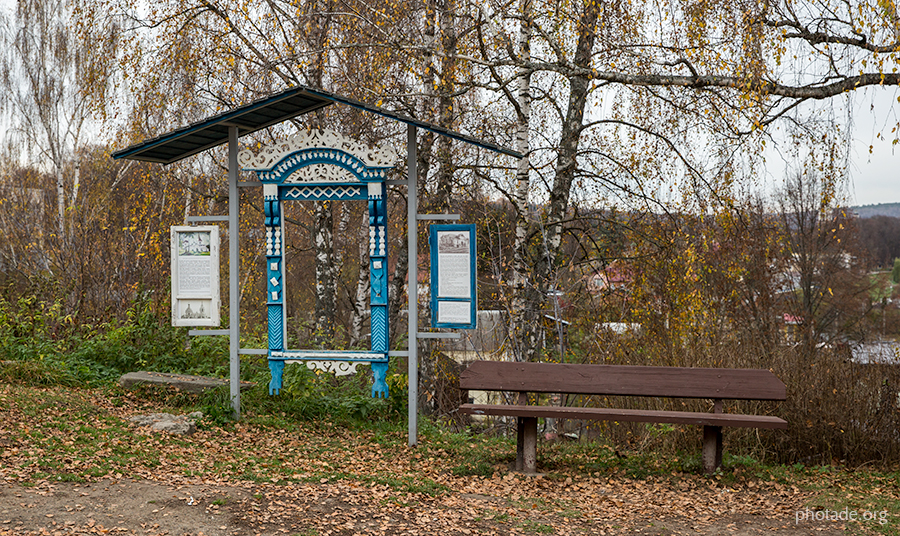 5. По всему городу установлены подобные образцы старинных наличников с исторической информацией о городе. На этих маленьких стендах можно узнать много интересного. Throughout the town, similar samples of old window casings with historical information about the town are installed. On these small stands one can learn many interesting things. |
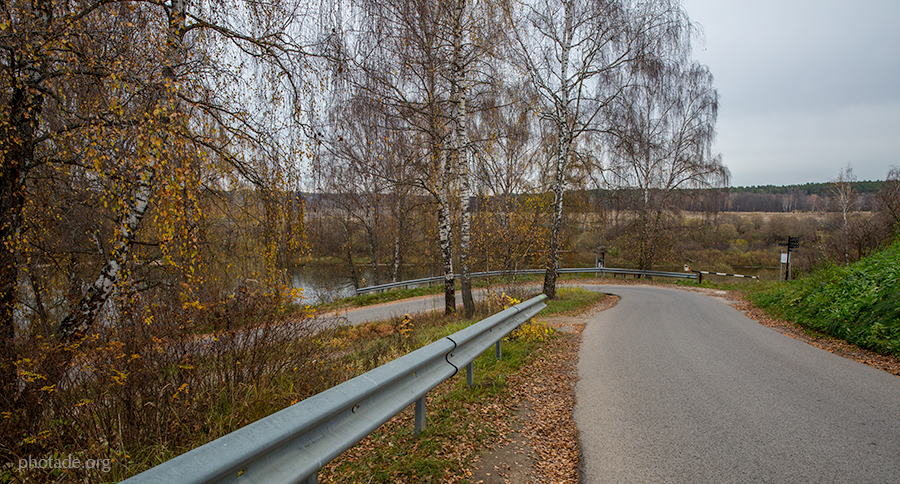 6. Тарусский серпантин: серия крутых поворотов на улице Ефремова. Данный поворот ведёт вглубь Игумного оврага, в котором находится святой источник и часовня Боголюбской Богоматери. Tarusa serpentine: a series of steep turns on Yefremov Street. This turn leads deep into the Igumnov ravine, in which there is a holy spring and a chapel of the Bogolyubsky Mother of God. |
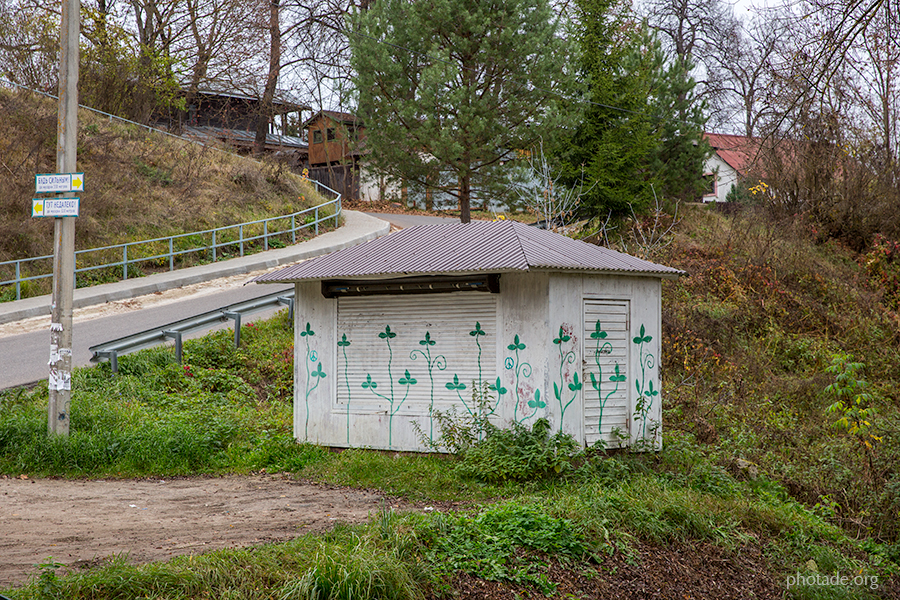 7. Граффити в городе мы не заметили ― из тех, что обычно молодёжь малюет на стенах. Да здесь и мест нет таких, чтобы их можно было тайком разукрасить. Именно поэтому этот нехитрый «декор» привлёк внимание ― простенько... не сказать, что со вкусом, но определённый милый наив в этом чувствуется. We did not notice graffiti in the town — of the kind that young people usually scrawl on walls. And there are no such places here either, where they could be secretly painted. That is precisely why this simple “decor” attracted attention — plain... not to say tasteful, but a certain sweet naivety is felt in it. |
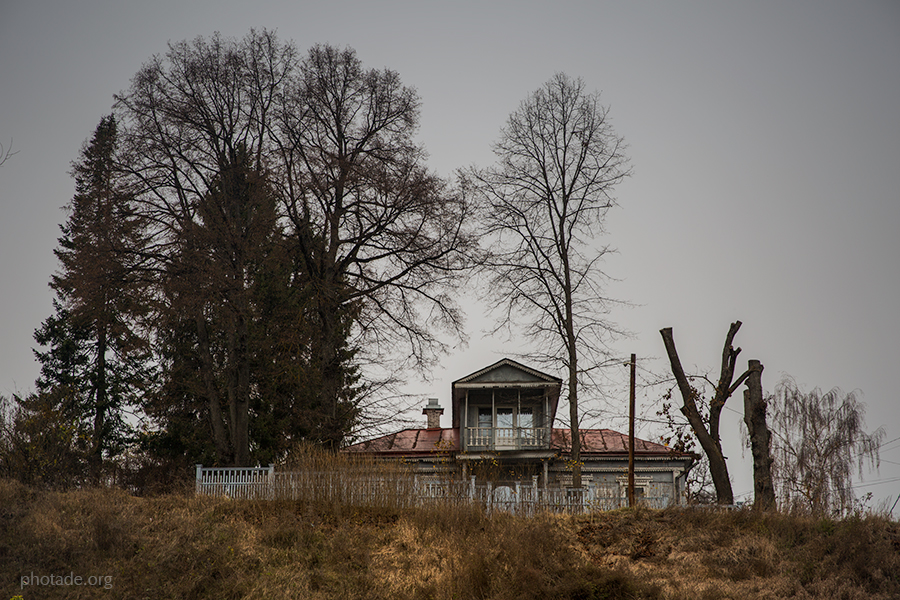 8. Дачные усадьбы 19 века часто ассоциируются именно с такой архитектурой, как на этой картинке. Здесь вид на Дом Виноградовых, памятник архитектуры, построенный в 1890 году. Сейчас это частное владение. 19th-century dacha estates are often associated with exactly such architecture as in this picture. Here is a view of the Vinogradov House, an architectural monument built in 1890. Now it is a private property. |
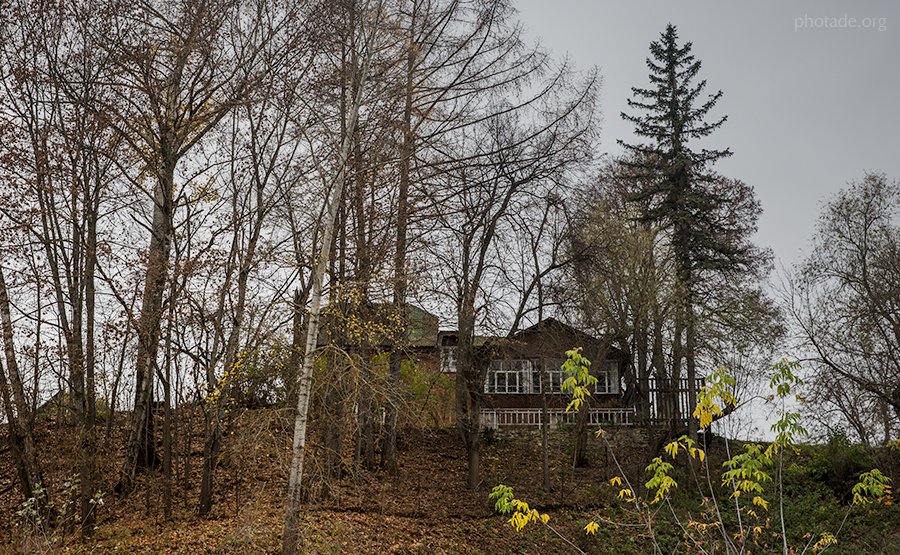 9. Здесь явно уже не памятник архитектуры, но домик тоже расположен очень хорошо, с него явно открываются красивые виды. Here it is clearly no longer an architectural monument, but the little house is also very well located; clearly beautiful views open up from it. |
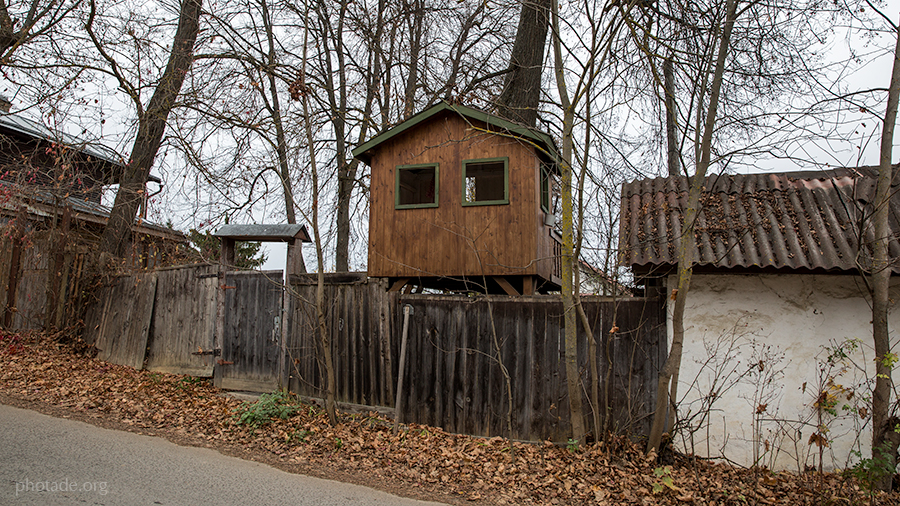 10. Домик на дереве. И традиционный русский бренд ― покосившийся забор, куда ж без него в русском поселении? A treehouse. And the traditional Russian brand — a crooked fence; where would one be without it in a Russian settlement? |
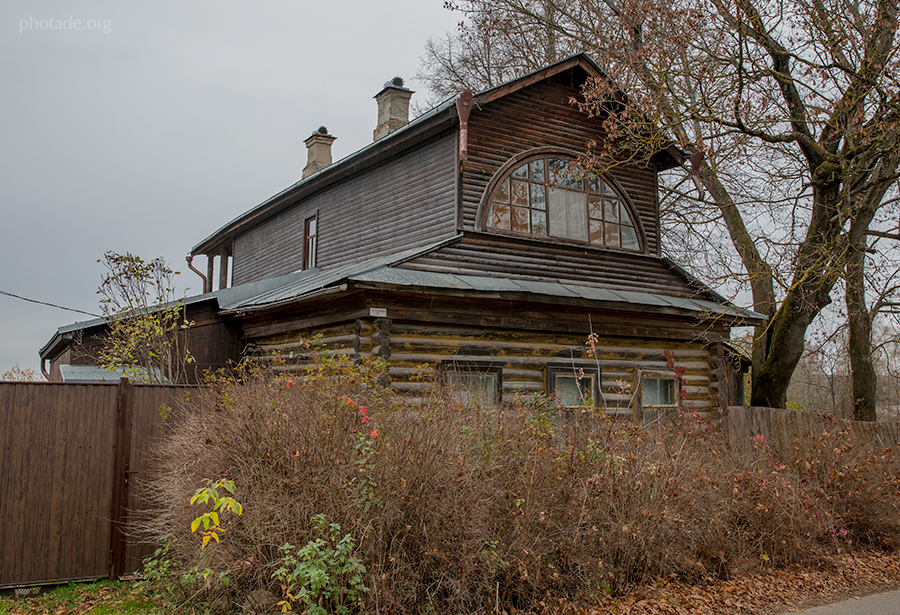 11. Очень симпатичный дом с красивым окном на втором этаже. В таком доме явно жили люди, не очень далёкие от творчества: второй этаж явно когда-то задумывался, как студия. A very pretty house with a beautiful window on the second floor. In such a house clearly lived people not very far from creativity: the second floor was clearly once conceived as a studio. |
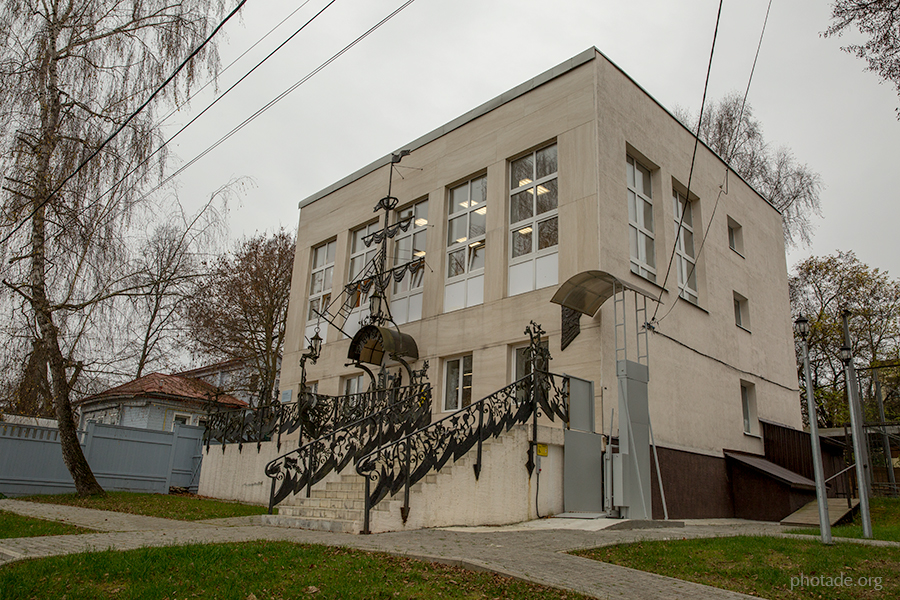 12. Тарусская районная детская библиотека им. Н.В. Богданова (был такой детский писатель, почётный гражданин Тарусы). Библиотека была создана по инициативе Богданова, построена в начале 1970-х на его личной земле, да и потратил он гонорар от своего сборника (источник). Входную группу украшает скульптурная композиция из металла за авторством А.Н. Волкова (источник), сделанная в технике «лирической металлопластики». Фасад обновили в 2015 году, благодаря чему эта «коробка» стала теперь очень симпатично выглядеть. Tarusa District Children's Library named after N.V. Bogdanov (he was a children's writer, an honorary citizen of Tarusa). The library was created on Bogdanov's initiative, built in the early 1970s on his personal land, and he also spent the fee from the publication of his collection (source). The entrance group is decorated with a sculptural composition made of metal by A.N. Volkov (source), made in the technique of "lyrical metal plasticity". The facade was updated in 2015, thanks to which this "box" now looks very pretty. |
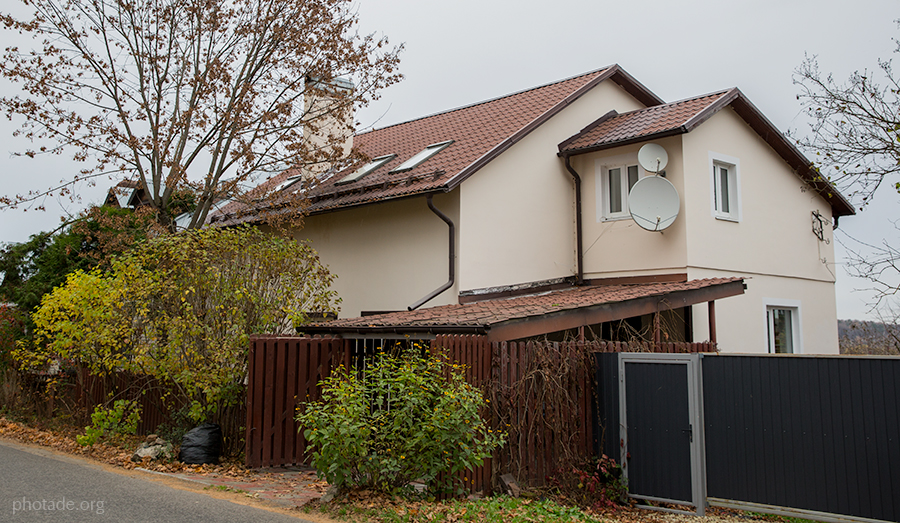 13. Пример современной и очень уютной архитектуры в исторической черте города. Вот о таком жилье должен мечтать среднестатистический россиянин, а не об ипотеке на 30 лет в человейнике. An example of modern and very cozy architecture within the historical area of the town. It is precisely the kind of housing the average Russian should dream of, and not of a 30-year mortgage in a human anthill. |
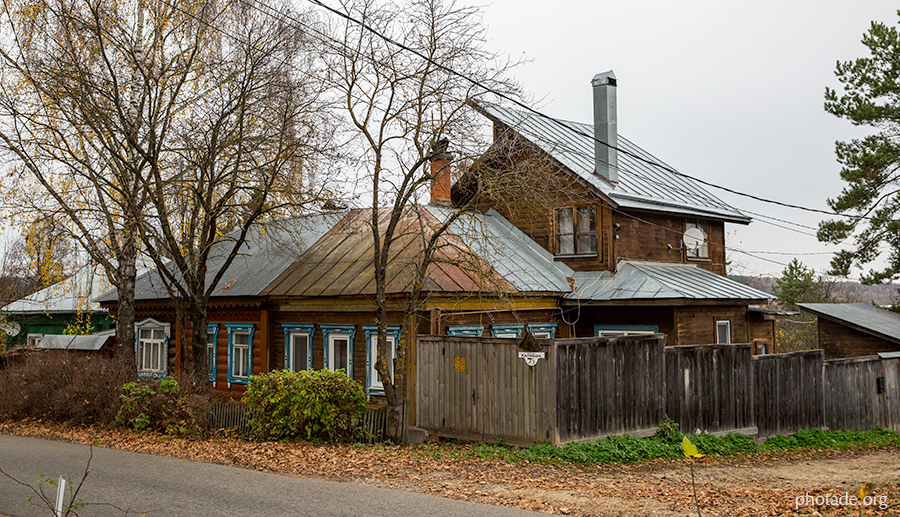 14. А это пример исторической застройки с современными надстройками. Судя по этому домику, в Тарусе тоже есть многоквартирные избы. This is an example of historical building with modern superstructures. Judging by this little house, there are also multi-apartment log houses in Tarusa. |
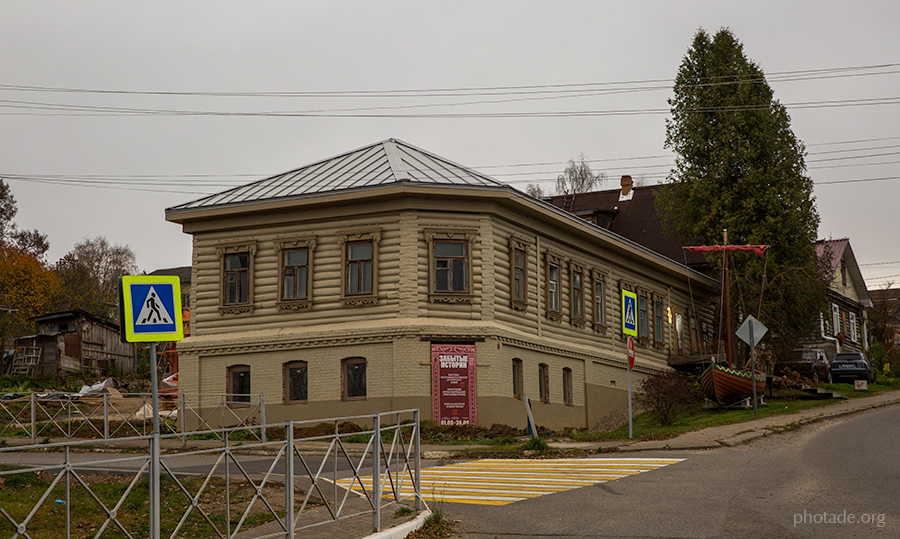 15. Купеческий дом Иванова, сейчас там находится музей «Забытые истории», посвящённый быту повседневной жизни простых жителей Тарусы. Это пример облагороженного (кстати, совсем недавно) традиционного купеческого дома, когда первый этаж кирпичный, а второй ― деревянный сруб, так называемый «полукаменный дом». Как пишет Википедия, такие дома в 19 веке были популярны у небогатых купцов и зажиточных мещан. У купцов на первом этаже был склад или магазин, а второй этаж ― жилой. У мещан было наоборот, первый этаж жилой, а второй мог сдаваться в аренду. The merchant Ivanov's house, now it houses the museum "Forgotten Stories", dedicated to the everyday life of ordinary residents of Tarusa. This is an example of a renovated (by the way, quite recently) traditional merchant house, where the first floor is brick and the second is a wooden log frame, the so-called "semi-stone house". As Wikipedia writes, such houses in the 19th century were popular among less wealthy merchants and well-to-do petty bourgeois. Merchants had a warehouse or shop on the first floor, and the second floor was residential. For the petty bourgeois it was the opposite: the first floor was residential, and the second could be rented out. |
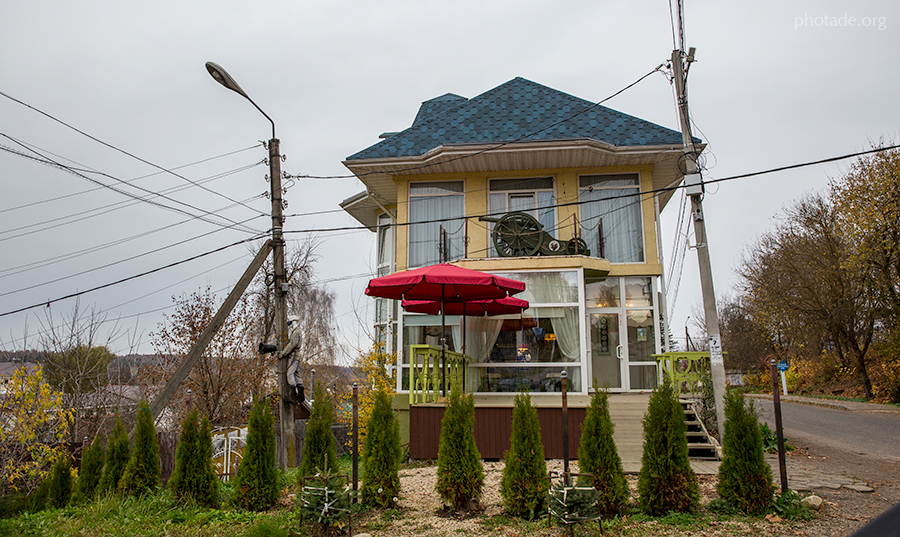 16. Кафе «Доброе утро». Привлекает пушкой на козырьке и кукольным чуваком на столбе с громкоговорителем в стиле Depeche Mode. Cafe "Good Morning". It attracts with a cannon on the canopy and a puppet dude on a pole with a loudspeaker in Depeche Mode style. |
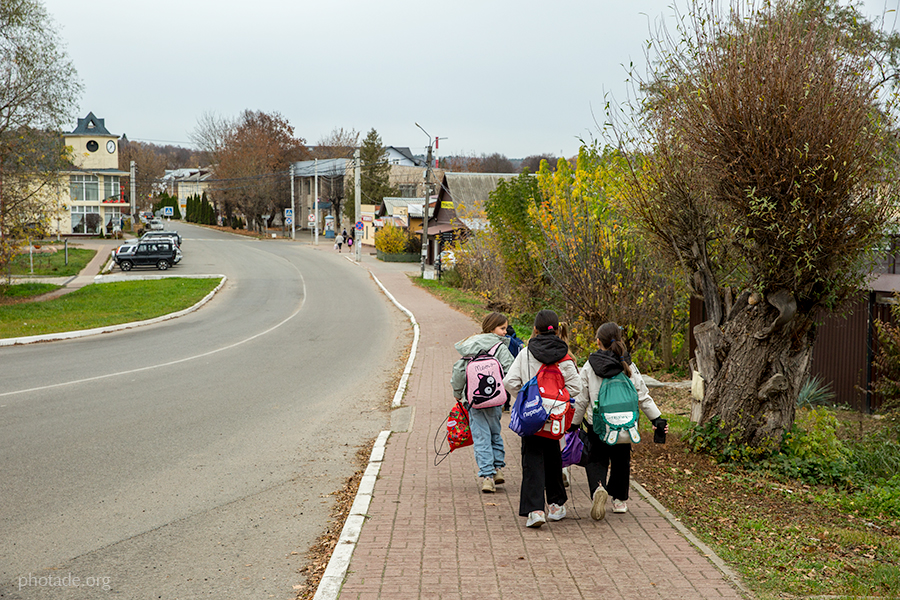 17. Улица Луначарского (бывшая Кирпичная). Эта улица существует со времен генерального плана застройки 1777 года (источник), а вот сам Луначарский к Тарусе никакого отношения не имеет. Просто он был когда-то первым наркомом просвещения РСФСР, поэтому можем отметить, что Луначарский в принципе радел за развитие культуры в СССР, поэтому его деятельность опосредованно положительно сказалась и на Тарусе в том числе. Вот местные власти и захотели увековечить его имя в своей топонимике. Lunacharsky Street (formerly Kirpichnaya). This street has existed since the general development plan of 1777 (source), but Lunacharsky himself has no relation to Tarusa. He was simply once the first People's Commissar of Education of the RSFSR, so we can note that Lunacharsky in principle cared for the development of culture in the USSR, therefore his activity indirectly had a positive effect on Tarusa as well. That is why the local authorities wanted to perpetuate his name in local toponymy. |
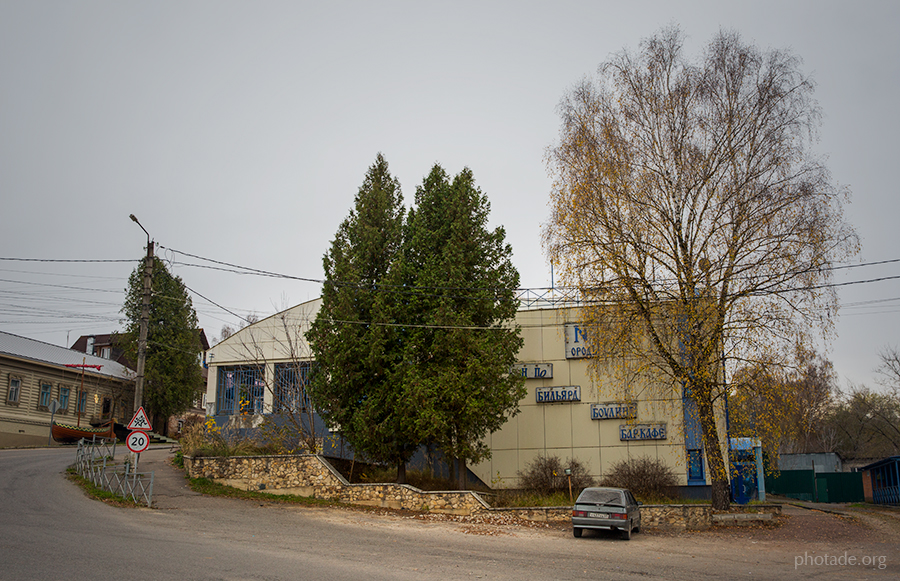 18. Отзывы в интернете говорят, что это не самая популярная точка в городе. И сейчас заведение выглядит заброшенным ― не всякий бизнес в Тарусе успешен. Reviews on the Internet say that this is not the most popular spot in the town. And now the establishment looks abandoned — not every business in Tarusa is successful. |
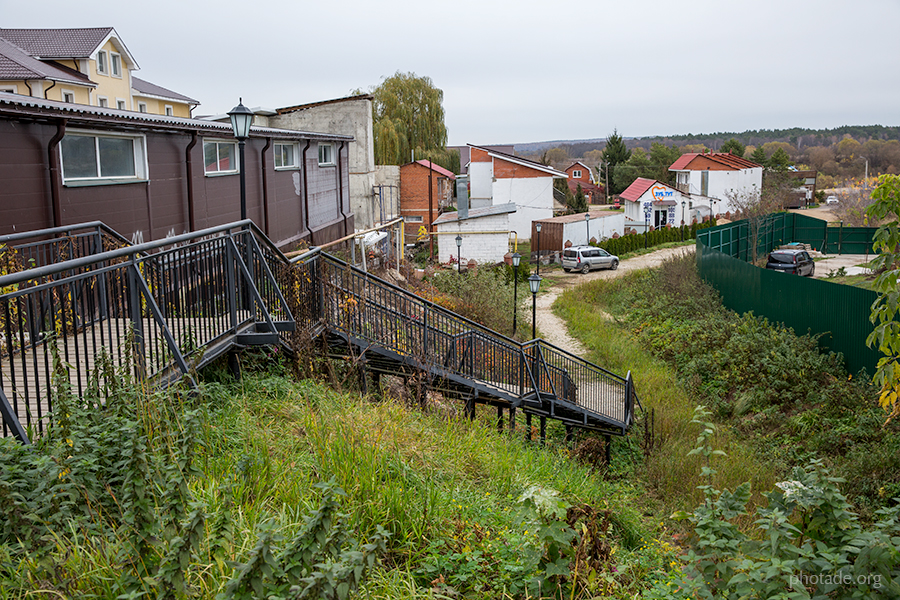 19. Высокий берег уступами спускается к реке, поэтому без лестниц в этом городе никак. Но всё чисто и аккуратно. Кстати, на улицах реально нет мусора. Город действительно очень чистый. The high bank descends to the river in terraces, so one cannot do without stairs in this town. But everything is clean and tidy. By the way, there is really no litter on the streets. The town is indeed very clean. |
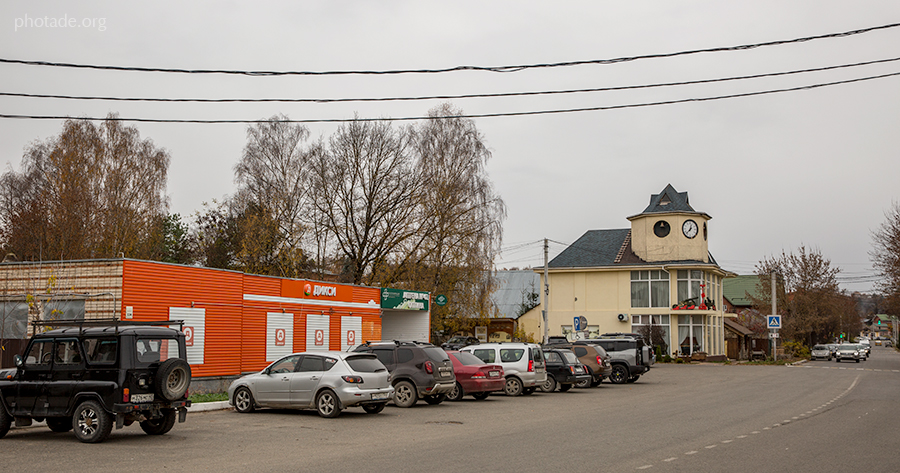 20. Улица Луначарского, пожалуй, одна из самых длинных в городе (почти 2 км). И одна из самых широких, особенно в зоне расположения различных магазинчиков. Широта улицы не может не радовать глаз ― тут место есть для всех: и для людей, и для машин. Так и должно быть. Lunacharsky Street is perhaps one of the longest in the town (almost 2 km). And one of the widest, especially in the area where various small shops are located. The width of the street cannot but please the eye — there is room here for everyone: both for people and for cars. That is how it should be. |
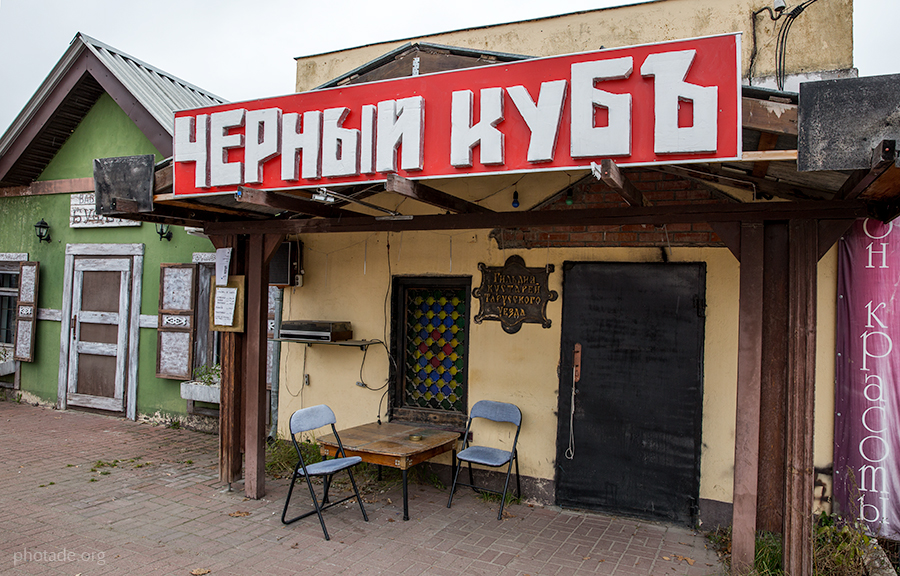 21. Выставочный зал «Чёрный Кубъ». Надпись на табличке: «Гильдия кустарей Тарусского уезда». Здесь с 2022 года располагается современная арт-галерея. Говорят, там внутри всё чёрное, ибо эта чернота символизирует собой космическую темноту, в которой ярко сияют звёзды ― работы выставляемых мастеров (источник). Exhibition hall "Black Cube". The inscription on the sign: "Guild of Artisans of Tarusa Uyezd". Since 2022, a modern art gallery has been located here. They say that inside everything is black, for this blackness symbolizes cosmic darkness, in which stars shine brightly — the works of the exhibited masters (source). |
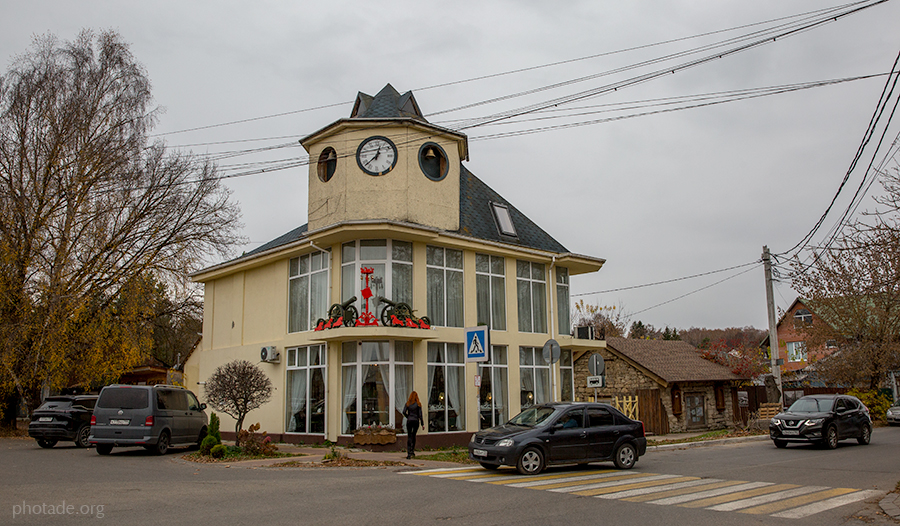 22. Кафе «Тарусское время», очень симпатичное, но абсолютно безалкогольное, видимо, рассчитано на публику с детьми. Кафе принадлежит тарусскому предпринимателю Владимиру Самохину, на фото 16 выше мы уже видели его второе заведение ― кафе «Доброе утро» (источник), хотя данные заведения позиционируются как семейный бизнес. По сути это кафе-музей, и создатель этого заведения очень интересный человек, так что рекомендую почитать интервью в источнике. Считается одной из обязательных точек притяжения в городе для заезжего обывателя. Cafe "Tarusskoye Vremya", very pretty, but absolutely non-alcoholic, apparently intended for an audience with children. The cafe belongs to the Tarusa entrepreneur Vladimir Samokhin; in photo 16 above we have already seen his second establishment — the cafe "Dobroye Utro" (source), although these establishments are positioned as a family business. In essence, this is a cafe-museum, and the creator of this establishment is a very interesting person, so I recommend reading the interview in the source. It is considered one of the obligatory points of attraction in the town for the visiting layman. |
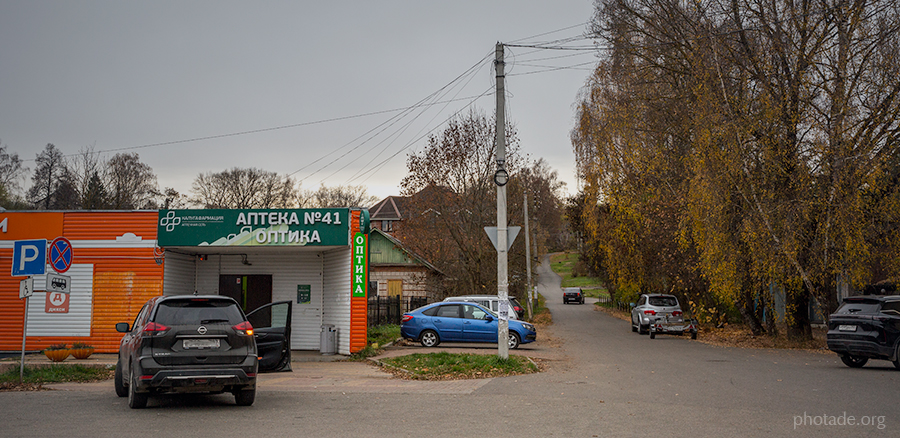 23. Кажется, что город тут заканчивается, но на самом деле вверх по улочке ещё есть дома. Просто этот город так и выглядит, как расслабленная деревня, где все чувствуют себя легко и свободно. Поэтому и паркуются, где хотят (небывалая роскошь для жителя столицы). Что касается аптеки, то она не 41-ая в городе, это её номер в сети государственного предприятия «Калугафармация». It seems that the town ends here, but in fact further up the little street there are still houses. It is just that this town looks like a relaxed village, where everyone feels easy and free. That is why they park wherever they want (an unprecedented luxury for a resident of the capital). As for the pharmacy, it is not the 41st in the town; this is its number in the network of the state enterprise "Kalugafarmatsiya". |
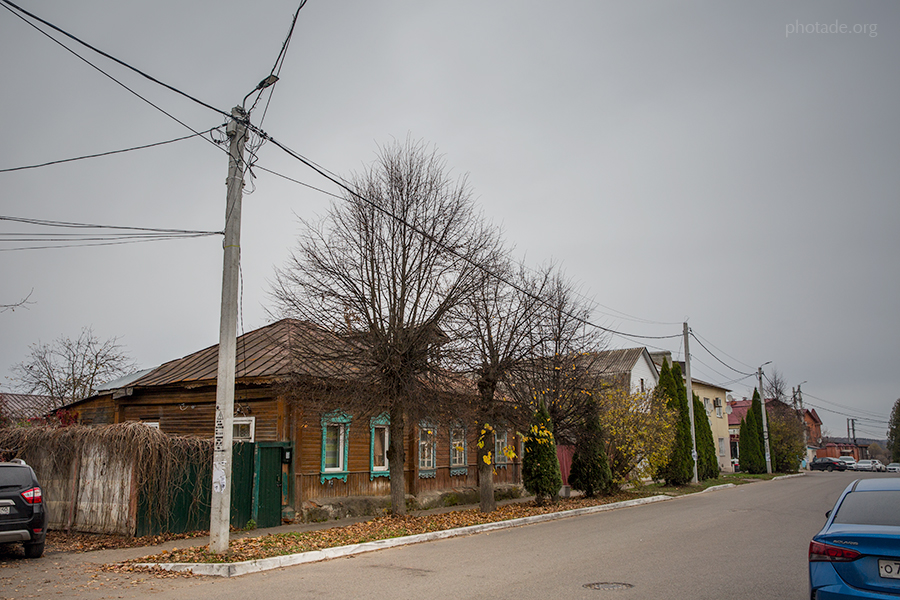 24. Улица Володарского: ещё одна широченная улочка в исторической части города. Volodarsky Street: another very wide little street in the historical part of the town. |
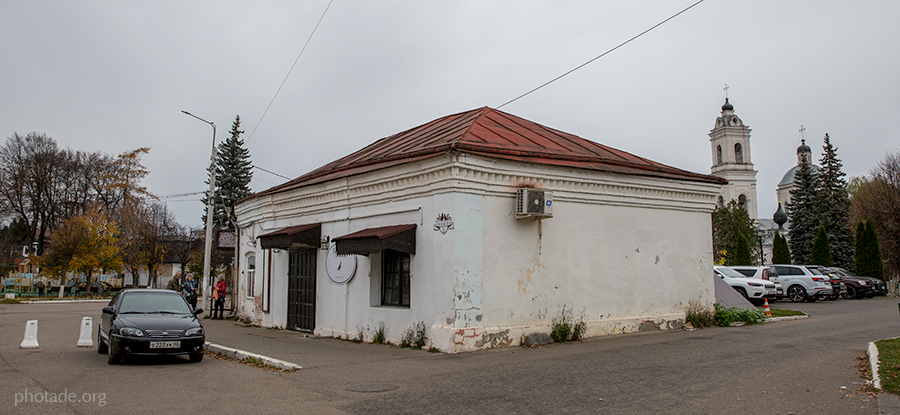 25. Здесь начинается самый центр города. Поэтому, разумеется, именно здесь находятся Торговые ряды, в которых торгуют до сих пор. На фото видно торец этого углового здания, построенного в 1890 году, а до этого здесь было деревянное строение. Здесь располагается большой сувенирный магазин с местной керамикой (Таруса ею славится), также находится несколько кафешек. В прошлом, говорят, всё здание было увешено вывесками (как, например, можно отчасти увидеть на старой фотографии здесь), которые после стихотворения Маяковского получили расхожее название «железные книги». Эти вывески содержали не сколько слова, сколько изображения товаров, что было удобно для людей без образования. Here begins the very center of the town. Therefore, of course, it is precisely here that the Trading Rows are located, in which they still trade. The photo shows the end wall of this corner building, built in 1890, and before that there was a wooden structure here. Here is located a large souvenir shop with local ceramics (Tarusa is famous for it), and there are also several cafes. In the past, they say, the whole building was hung with signs (as, for example, can be partly seen in the old photograph here), which, after Mayakovsky's poem, received the common name "iron books". These signs contained not so much words as images of goods, which was convenient for people without education. |
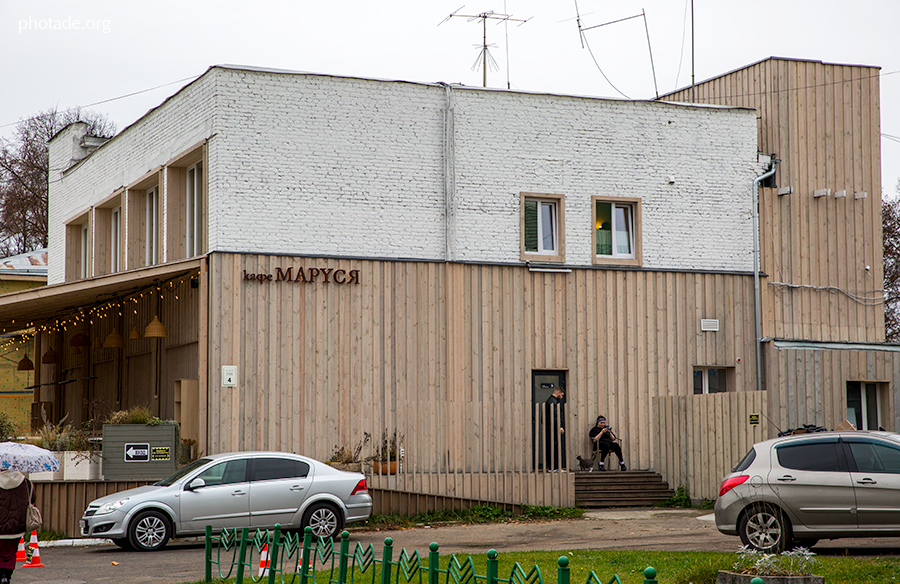 26. Кафе «Маруся» со странным написанием названия. Советский кирпичный куб облагородили досками, получилось очень симпатично. Еда неплохая, но в меню может не всё быть. Впрочем, для несезона это нормально. Напротив, порадовало, что когда мы туда пришли, больше половины столиков было занято. Приятно видеть, что люди в город едут, это дарит надежду на многое. Cafe "Marusya" with a spelling of the name that is strange for Russian. The Soviet brick cube was improved with boards, and it turned out very pretty. The food is not bad, but not everything may be on the menu. However, for the off-season this is normal. On the contrary, it was pleasing that when we came there, more than half of the tables were occupied. It is pleasant to see that people are coming to the town; this gives hope for many things. |
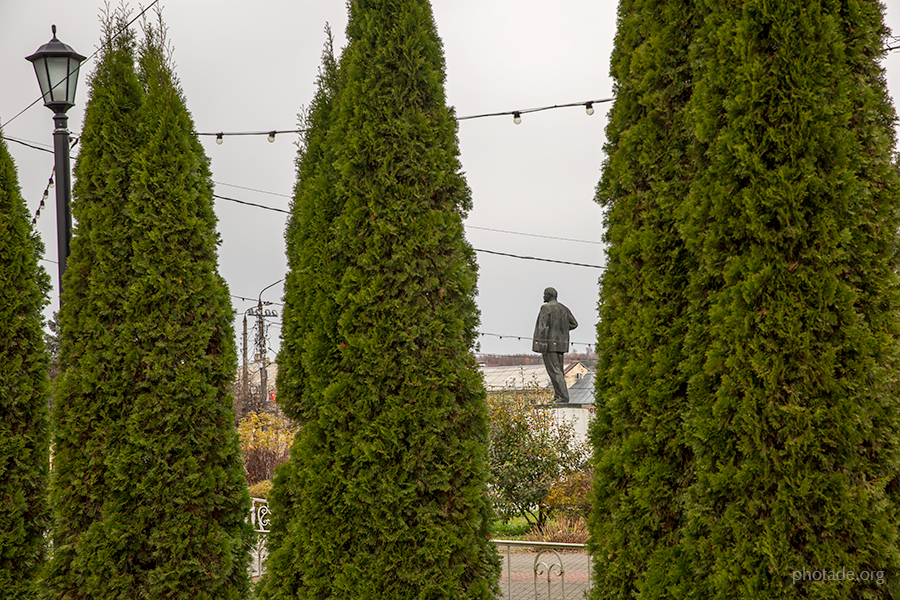 27. И, конечно, в Тарусе тоже есть памятник В.И. Ленину, куда уж без него в постсоветском пространстве? Главный атрибут центра советского города. Кстати, очень хорошо сделанный. Автор П.И. Бондаренко (тоже житель Тарусы, здесь есть его музей-мастерская), памятник установлен в 1962 году. Жители подумывают включить этот памятник в объект культурного наследия. Впрочем, тут объектом культурного наследия является весь район, так что, может быть, отдельно включать Ильича в эти объекты и не нужно. And, of course, Tarusa also has a monument to V.I. Lenin — can there really be a city without it in the post‑Soviet space? The main attribute of the center of a Soviet town. By the way, very well made. The author is P.I. Bondarenko (also a resident of Tarusa; there is his museum-workshop here), the monument was installed in 1962. Residents are thinking about including this monument as an object of cultural heritage. However, here the entire district is a cultural heritage object, so perhaps it is not necessary to include Ilyich separately in these objects. |
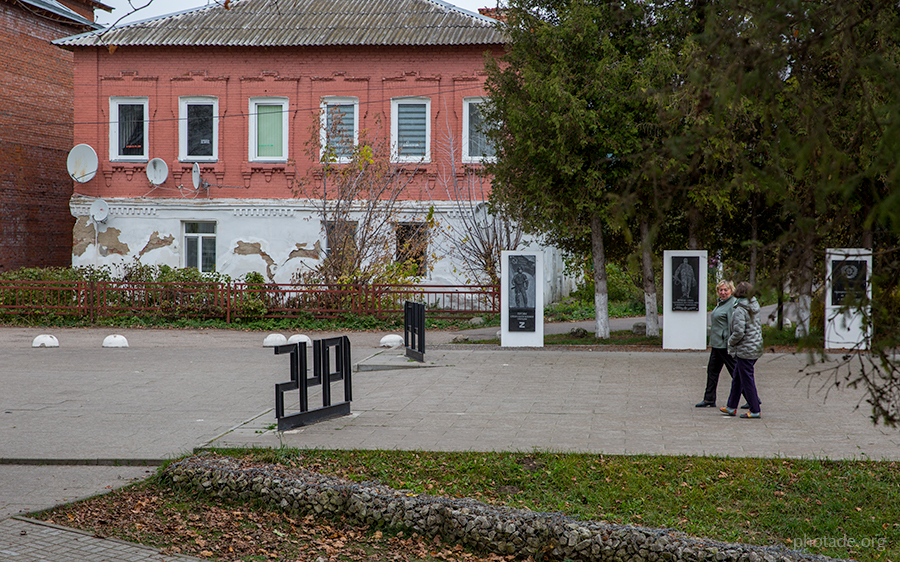 28. Аллея у Обелиска Славы. Здесь находятся памятники М.Г. Ефремову, Жертвам радиационных катастроф, Стела в честь участников локальных войн и военных конфликтов и памятник героям СВО. А меня неприятно удивили цифры «1945»: извините, но с этой стороны они почему-то напоминают один символ прошлого века, который сейчас запрещен на территории РФ. Надо было авторам другой шрифт выбрать или по-другому эти цифры оформить. The alley at the Obelisk of Glory. Here are located monuments to M.G. Yefremov, to the Victims of radiation catastrophes, a Stele in honor of the participants of local wars and military conflicts, and a monument to the heroes of the "special military operation". But I was unpleasantly surprised by the figures "1945": excuse me, but from this side they for some reason resemble a symbol of the past century that is now banned on the territory of the Russian Federation. The authors should have chosen a different font or designed these figures differently. |
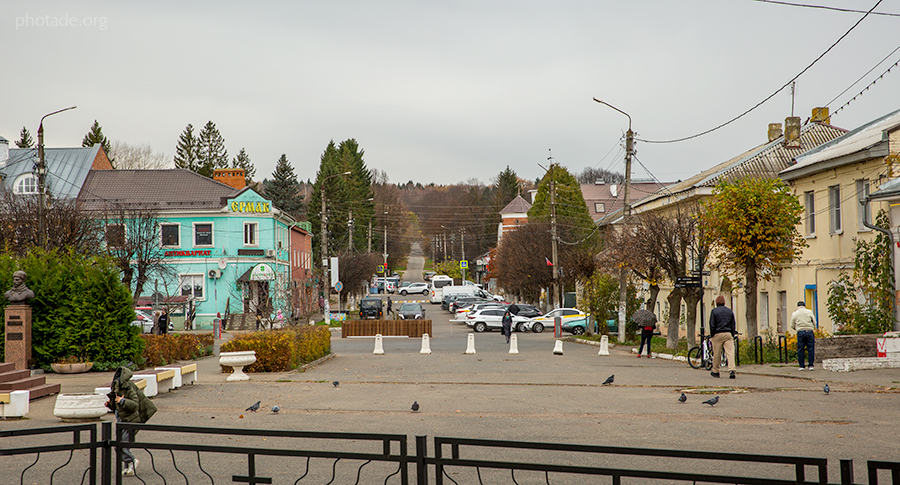 29. Улица Розы Люксембург. Это одна из старейших улиц города, но понятно, почему ей не вернули её историческое название: раньше она называлась Кладбищенская (источник), потому что по ней можно было попасть от Собора (Петра и Павла, решётку которого мы видим на самом переднем плане) на кладбище (ныне оно называется Старое кладбище). Правда, в ходе переименования улиц местные депутаты решили, что пусть уж она будет называться Посадской (см. тот же источник), но эта инициатива пока не нашла своей реализации. В результате улица до сих пор сохраняет своё советское наименование. А выглядит она совершенно купеческой. Rosa Luxemburg Street. This is one of the oldest streets of the town, but it is clear why its historical name was not returned to it: formerly it was called Kladbishchenskaya (Cemetery) (source), because along it one could get from the Cathedral (of Peter and Paul, the fence of which we see in the very foreground) to the cemetery (now it is called the Old Cemetery). True, in the course of the renaming of streets, local deputies decided that let it be called Posadskaya (see the same source), but this initiative has not yet found its realization. As a result, the street still retains its Soviet name. And it looks completely merchant-like. |
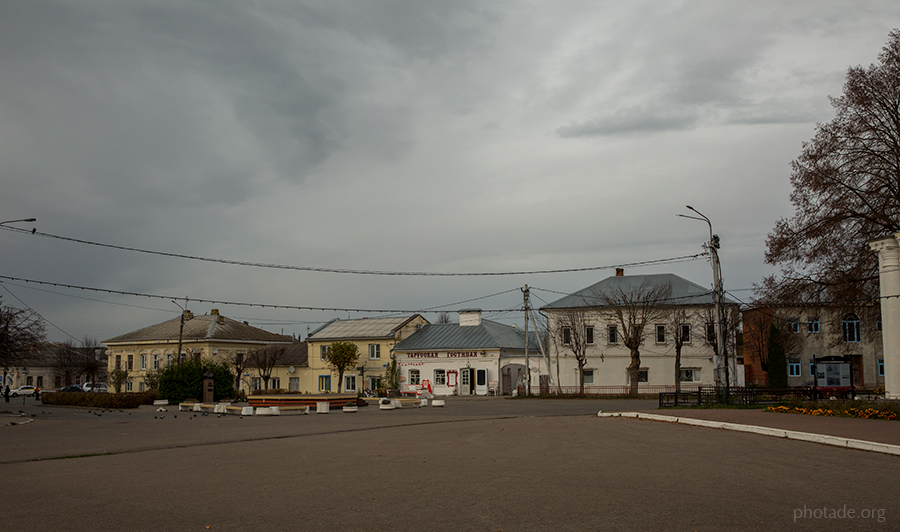 30. Старые домики у Соборной площади. Слева от центра видно законсервированный на зиму фонтан перед памятником, единственный в городе. Фонтан современный, открыт был в 2010 году (источник). На месте фонтана когда-то находилась так называемая «бассейка», о которой мы поговорим в 41-ой фотографии. Old little houses by the Cathedral Square. To the left of the center, one can see the fountain in front of the monument, conserved for the winter, the only one in the town. The fountain is modern, it was opened in 2010 (source). In the place of the fountain there was once the so-called "basseyka", which we will talk about in the 41st photo. |
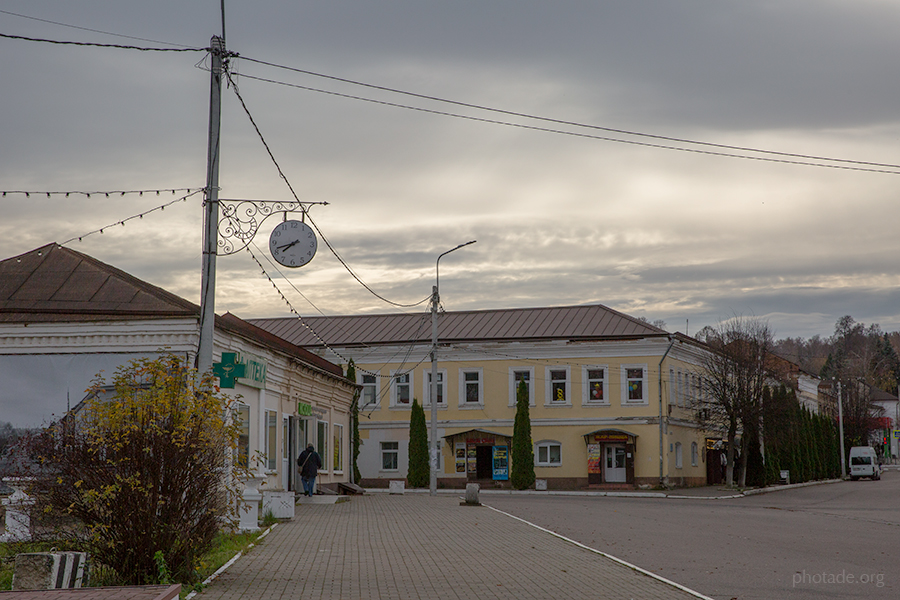 31. Ещё пример исторической застройки. Простая архитектура, но зато не бессмысленная, здесь на самом деле бойкое торговое место. Another example of historical buildings. Simple architecture, but not meaningless — actually, it is a brisk trading place here. |
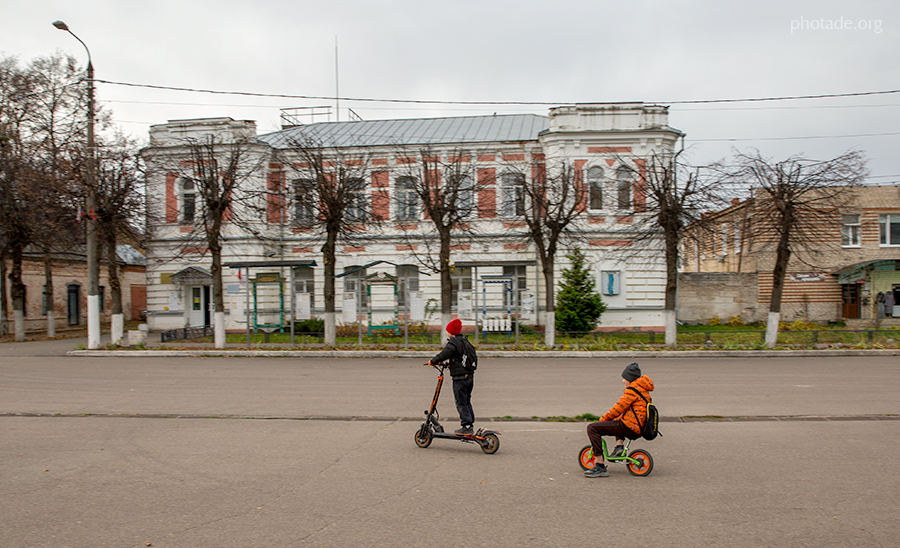 32. Катающиеся дети на фоне местного ЗАГСа. В начале 20 века это было здание Госбанка (уездное отделение Казначейства). Но прикол этого здания в другом: оно строилось как железнодорожный вокзал (источник), который в Тарусе так и не случился. Поэтому в 1903 году здание передали Казначейству и уездному управлению полиции (источник). ЗАГСом это здание стало уже в советские годы. Children skating in front of local registry office (ZAGS). In the early 20th century, this was the State Bank building (a district branch of the Treasury). But the funny thing about this building is different: it was built as a railway station (source), which never happened in Tarusa. Therefore, in 1903, the building was transferred to the Treasury and the district police department (source). It became a ZAGS already in Soviet years. |
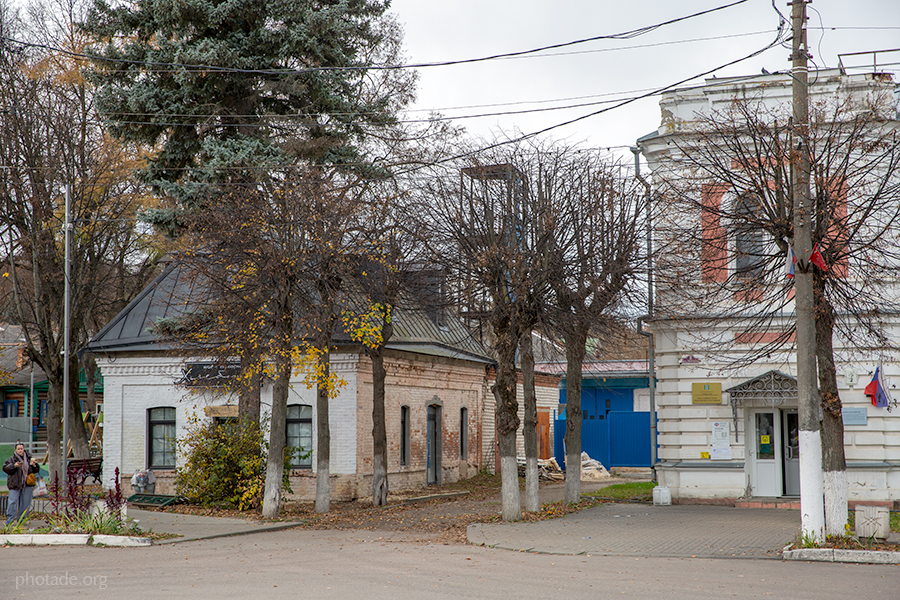 33. В городе сохранилось очень много старинных хозяйственных построек. Поэтому периодически можно увидеть такие маленькие домики, как на фото слева. A lot of old utility buildings have been preserved in the town. Therefore, periodically one can see such small houses as in the photo on the left. |
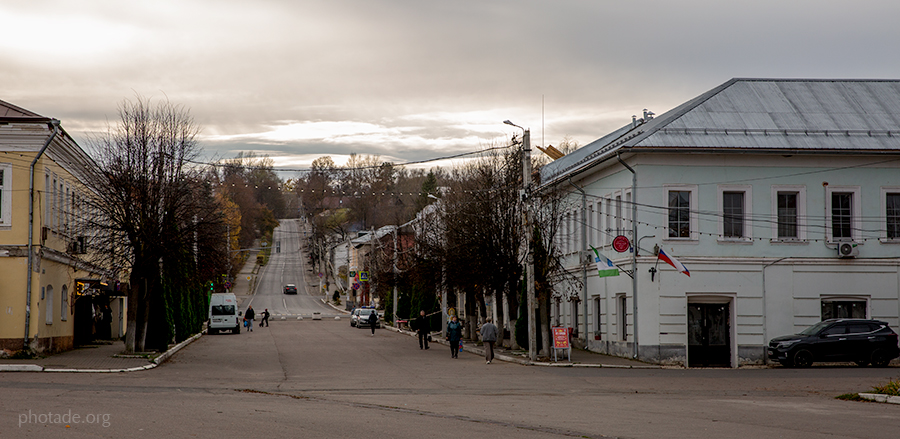 34. Улица Ленина. До перекрёстка со светофорами (слева видно его зелёный огонёк) ― пешеходная зона. Раньше эта улица называлась Калужская (источник), и отсюда действительно можно по прямой до Калуги доехать. Справа, кстати, двухэтажное голубоватое здание ― это какой-то дорогущий бутик-отель со стоимостью номеров в половину средней зарплаты обычного тарусянина (это к вопросу, какие люди сюда иногда приезжают, скажем так, погостить). Lenin Street. Up to the intersection with traffic lights (its green light is visible on the left) is a pedestrian zone. Previously this street was called Kaluzhskaya (source), and from here one can indeed drive straight to Kaluga. On the right, by the way, the two-storey bluish building is some very expensive boutique hotel with room prices at half the average salary of an ordinary Tarusian (this is in response to the question of what kind of people sometimes come here to stay for a while). |
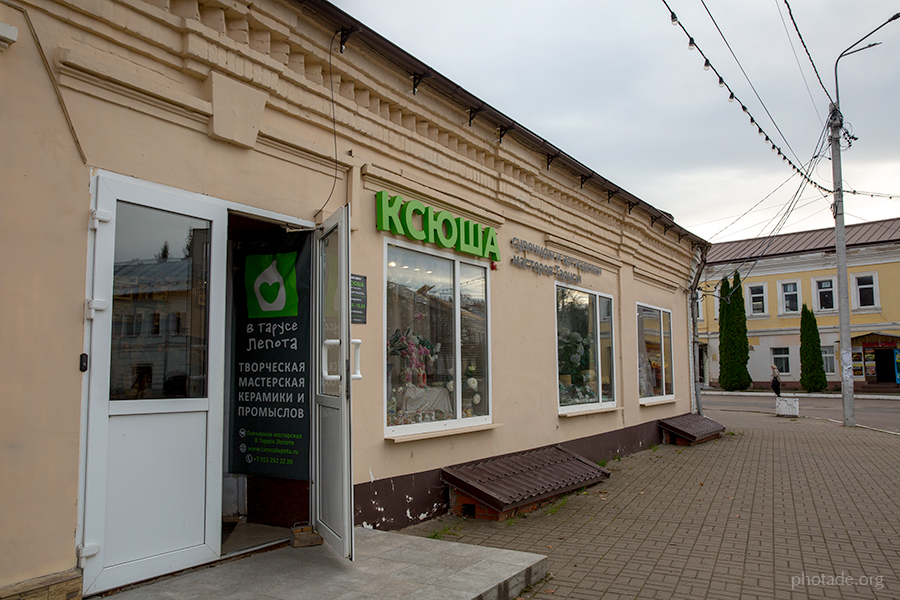 35. «Ксюша», наверное, самый главный сувенирный магазин Тарусы, находится в самом центре на улице Ленина в торговых рядах, поэтому пропустить этот магазинчик туристу попросту невозможно. "Ksyusha", probably, is the maine souvenir shop of Tarusa, located in the very center on Lenin Street in the Trading Rows, therefore it is simply impossible for a tourist to miss this little shop. |
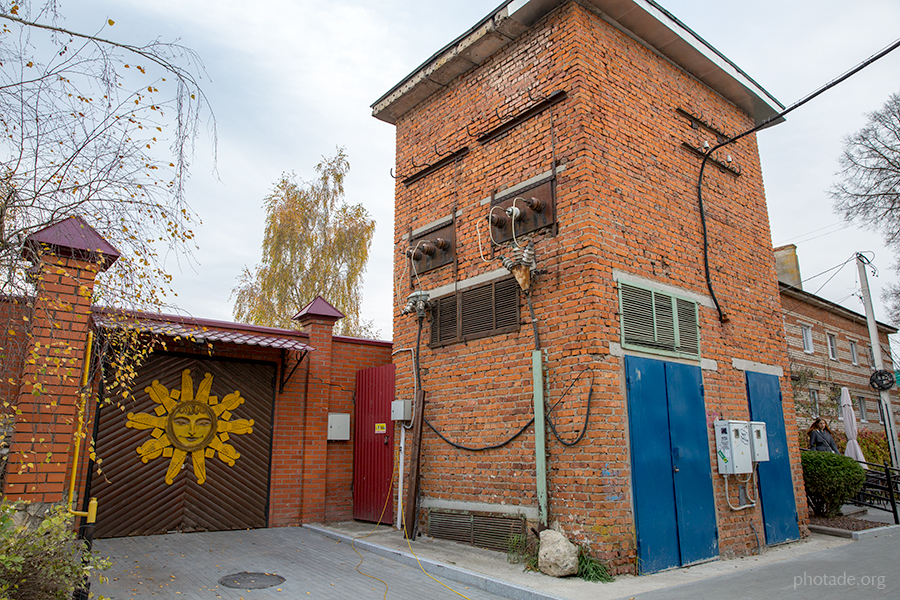 36. Кирпичная трансформаторная подстанция. Кстати, полноценное электричество в Тарусе появилось только в конце 1950-х годов и только благодаря К.Г. Паустовскому, который был почётным жителем города. A brick transformer substation. By the way, full-fledged electricity in Tarusa appeared only in the late 1950s and only thanks to K.G. Paustovsky, who was an honorary resident of the town. |
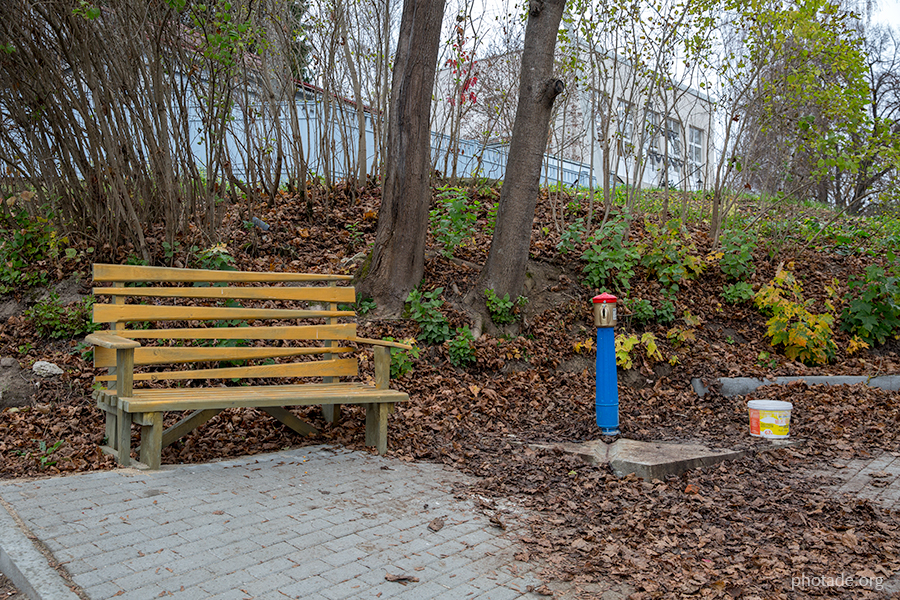 37. Раз уж речь зашла о Паустовском, то здесь стоит поговорить о его деяниях для города Тарусы. Прежде всего существенное влияние на развитие города оказало его «Письмо из Тарусы», впервые опубликованное в газете «Правда» 26 июня 1956 года. Этот момент можно назвать поворотной точкой в благоустройстве города. В связи с чем в 2026 году к 780-летию Тарусы открыли Колонку Паустовского, чтобы напоминать всем, какой силой обладает писательское слово (источник). Рядом с колонкой установили лавочку, созданную мастером Андреем Губаревым (источник). Since the conversation has turned to Paustovsky, it is worth talking here about his deeds for the town of Tarusa. First of all, his "Letter from Tarusa", first published in the newspaper "Pravda" on June 26, 1956, had a significant influence on the development of the town. This moment can be called a turning point in the improvement of the town. In this connection, in 2026, for the 780th anniversary of Tarusa, the Paustovsky Column was opened to remind everyone of what power the writer's word possesses (source). Next to the column, a bench created by master Andrey Gubarev was installed (source). |
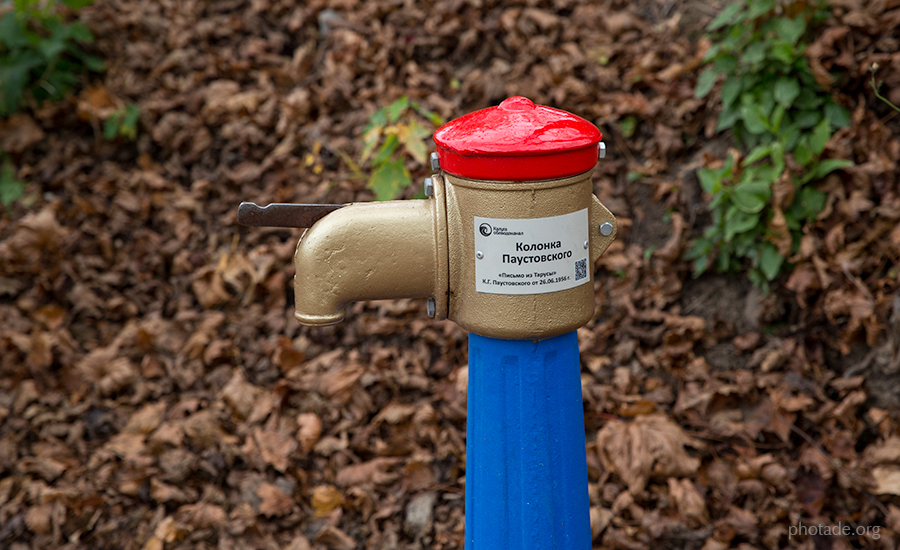 38. На колонке есть QR-код, который ведет на «Письмо из Тарусы». Советую его почитать, это действительно сильный текст, который, к сожалению, сегодня, наверное, ещё более актуален, особенно если под словом «Таруса» подразумевать слово «Россия». А уж под следующими словами Константина Георгиевича из этого письма невозможно не подписаться: «Необходимо полное внимание к малым городам. Надо превратить их из бедных родственников в полноценных граждан и дать простор развитию всех их возможностей». Это на самом деле единственный способ дать настоящее развитие нашей стране. Очень точная метафора: маленькие городки и впрямь как бедные родственники, хотя именно они должны стать основой процветания и благополучия России, а не федеральный центр, который должен быть всего лишь небольшой казённой конторкой и не более того. Но, к сожалению, людей с «мёртвыми глазами», по меткому выражению Паустовского, сейчас во власти полным-полно. Хорошо, что есть такие островки, как Таруса, где от этого можно действительно отдохнуть. On the column there is a QR code that leads to the "Letter from Tarusa". I recommend reading it, it is indeed a strong text, which, unfortunately, today, probably, is even more relevant, especially if by the word "Tarusa" one means the word "Russia". And it is simply impossible not to subscribe to the following words of Konstantin Georgiyevich from this letter: "Complete attention to small towns is necessary. They must be turned from poor relatives into full-fledged citizens and given scope for the development of all their opportunities". This is actually the only way to give real development to our country. A very precise metaphor: small towns are indeed like poor relatives, although it is precisely they who should become the basis of the prosperity and well-being of Russia, and not the federal center, which should be merely a small government office and nothing more. But, unfortunately, people with "dead eyes", according to Paustovsky's apt expression, are now plentiful in power. It is good that there are such islands as Tarusa, where one can really rest from this. |
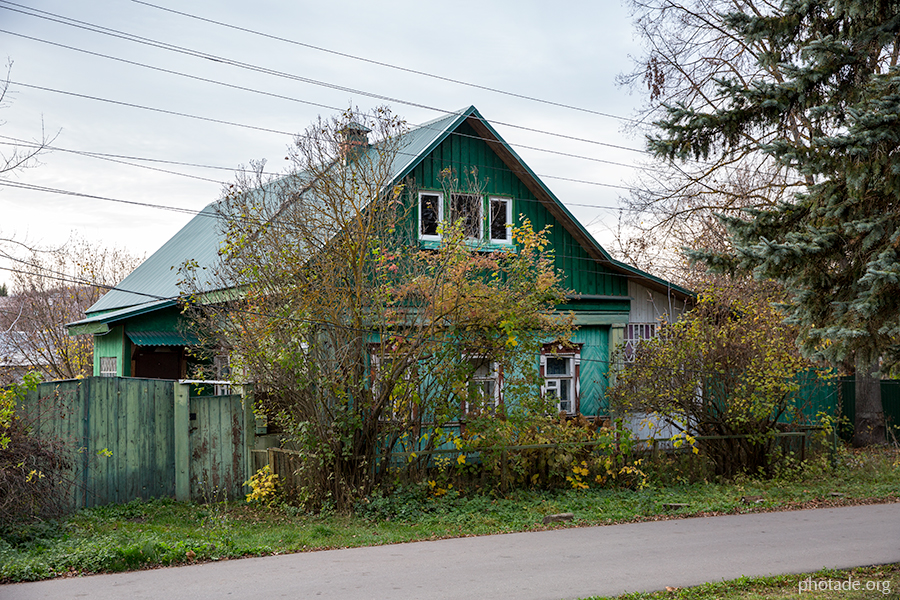 39. Пример советской застройки сельского типа в самом центре города. An example of Soviet rural-type development in the very center of the town. |
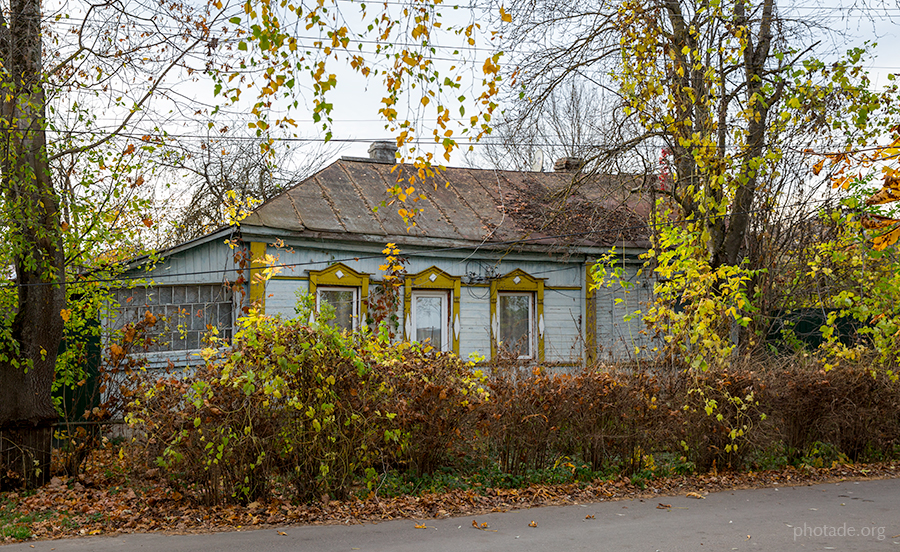 40. Ещё один частный советский домик. Another private Soviet little house. |
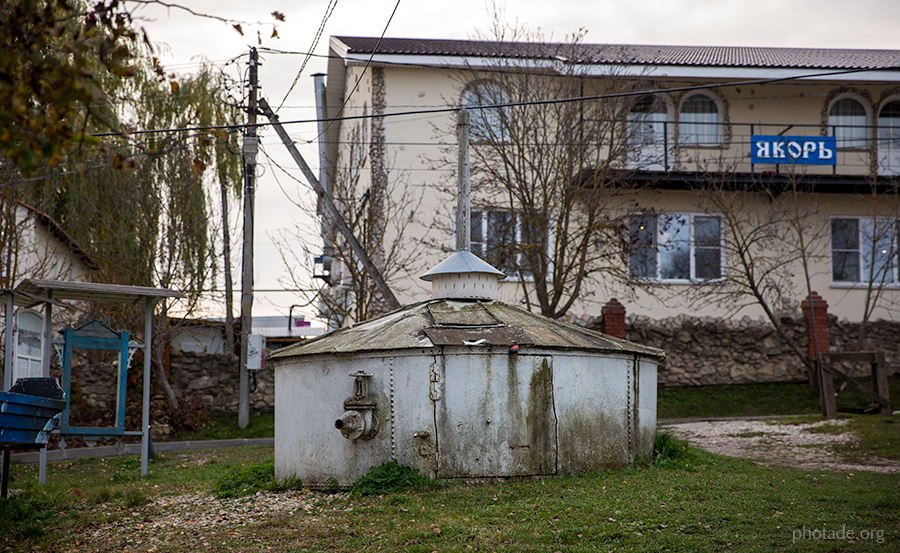 41. Здесь на фото мы видим так называемую водоразборную «бассейку» (безусловно, однокоренную со словом «бассейн») ― так в простонародье называли эти закопанные в землю резервуары, построенные в начале 20 века для снабжения горожан водой (источник). Эти резервуары ― часть уникальной системы, которая обеспечивала бесперебойное водоснабжение вплоть до 1960-х годов, пока благодаря стараниям Паустовского в Тарусе не запустили современный водопровод. Но система эта неудобная, к этим резервуарам стекались люди с вёдрами буквально со всех сторон. Некоторым приходилось идти до них по 2-3 километра, поэтому вода в Тарусе в первой половине 20 века была очень ценным ресурсом. При этом колодцы здесь не выкопать, высокий берег и водоносные пласты залегают очень глубоко. Брать же воду для питья из Оки после становления советской промышленности было уже не принято ― Ока к этому времени уже давно утратила пригодность для питья. Вот и получается, что город был аж на двух реках, а с водой были проблемы. Here in the photo we see the so-called water-drawing "basseyka" (undoubtedly cognate with the Russian word "bassein" ("pool")) — this is how in common parlance these reservoirs buried in the ground were called, built in the early 20th century to supply the townspeople with water (source). These reservoirs are part of a unique system which provided an uninterrupted water supply up until the 1960s, until, thanks to Paustovsky's efforts, a modern water supply system was launched in Tarusa. Old system was inconvenient; people with buckets flocked to these reservoirs literally from all sides. Some had to walk to them for 2-3 kilometers, therefore water in Tarusa in the first half of the 20th century was a very valuable resource. At the same time, it is impossible to dig wells here; the high bank and aquifers lie very deep. And taking water for drinking from the Oka after the establishment of Soviet industry was no longer customary — by this time the Oka had long lost its suitability for drinking. So it turns out that the town was on as many as two rivers, but there were troubles with water. |
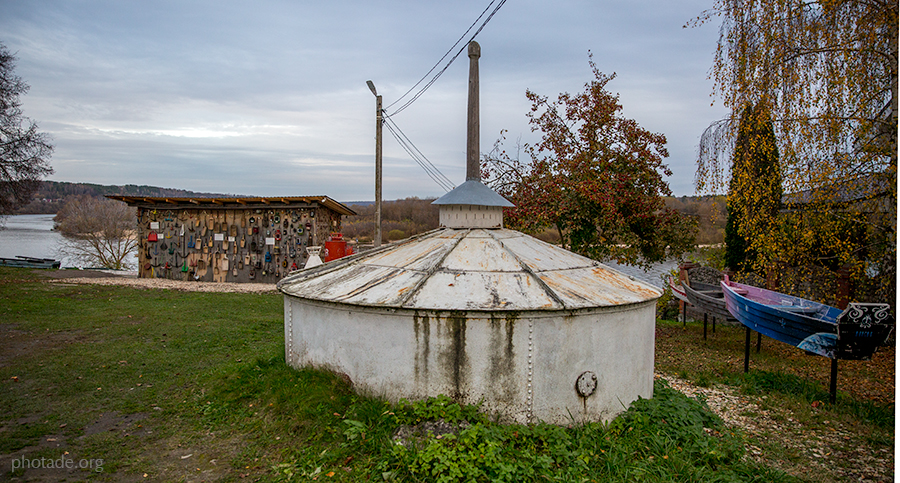 42. Как пишет источник, система была в некотором роде уникальная, хотя самотёчное водоснабжение в российской инженерной мысли нередко использовалось (например, самотёчные водопроводы были в Гороховце, в поволжской Сарепте, а также с такой системы началось московское водоснабжение из Мытищ (источник)). Уникальность данного водоснабжения заключается в его строении: все три резервуара (накопительный и два приёмных) находились на одной высоте 127 м над уровнем моря. Чугунными трубами эти резервуары были объединены в сообщающиеся сосуды. Насосы для заполнения бассеек не требовались. Вся система естественным образом питалась от источника, находящегося в Игумновом овраге. Здесь можно посмотреть, как раньше люди приезжали сюда за водой. As the source writes, the system was in some way unique, although gravity-fed water supply was often used in Russian engineering thought (for example, gravity-fed water supply systems existed in Gorokhovets, in the Volga region of Sarepta, and also Moscow's water supply from Mytishchi began with such a system (source)). The uniqueness of this water supply lies in its structure: all three reservoirs (one storage and two intake) were located at the same height of 127 m above sea level. Cast-iron pipes united these reservoirs into communicating vessels. Pumps for filling the basseykas were not required. The whole system was naturally fed from a spring located in the Igumnov ravine. Here one can see how people used to come here for water in the past. |
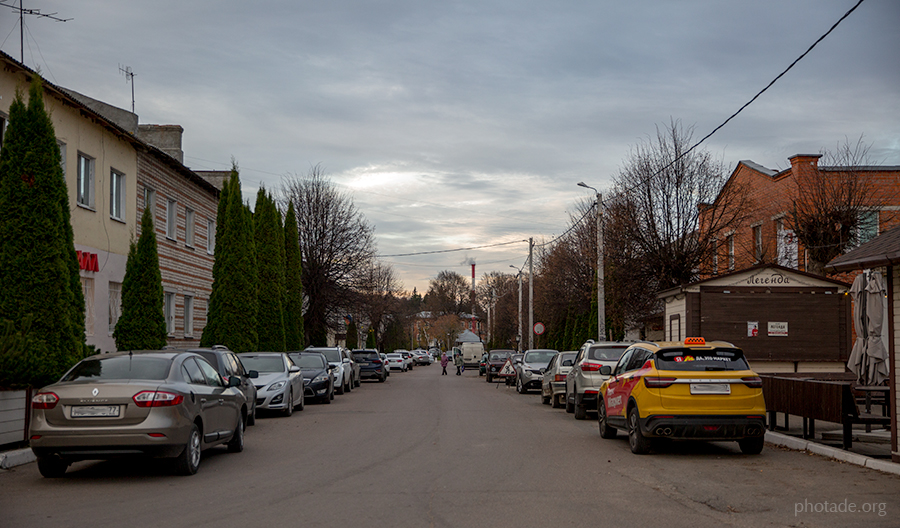 43. Октябрьская улица. До советского периода наименовалась Воскресенской (источник). Тоже довольно оживлённое место, к тому же, здесь находится много различных учреждений, так что здесь машины больше не туристические, а служащих. Oktyabrskaya Street. Until the Soviet period it was called Voskresenskaya (source). Also a rather lively place; moreover, many various institutions are located here, so the cars here are mostly not tourists' but employees'. |
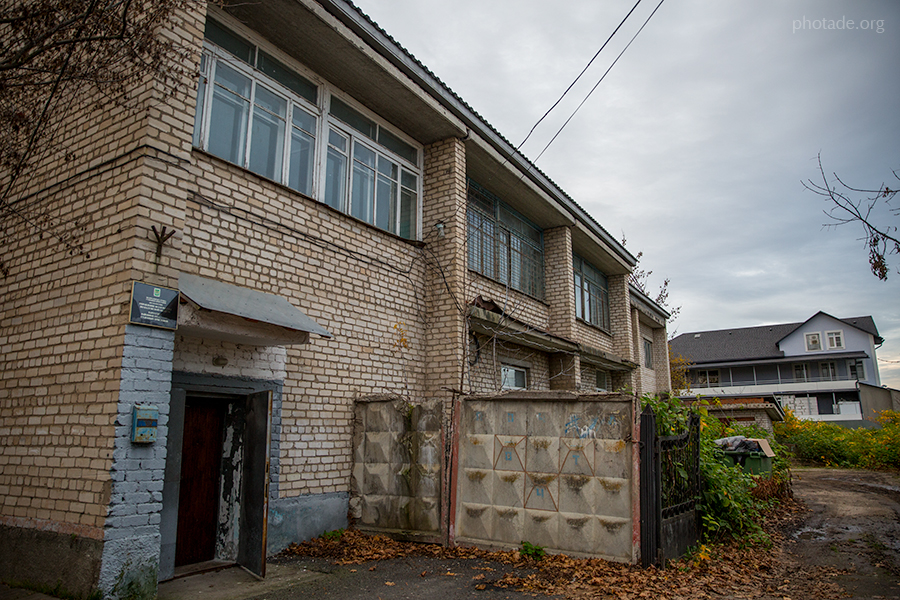 44. Задворки почты, а открытая дверь ведёт в отделение службы судебных приставов. Советская застройка, и заведения не самые весёлые, так скажем. На заднем плане справа виднеется верхняя часть здания Фабрики-Кухни Верзилиных ― одна из важнейших кулинарных точек Тарусы. The backside of the post office, and the open door leads to the office of the bailiff service. Soviet building, and the establishments are not the most cheerful, so to speak. In the background on the right, the upper part of the building of the Verzilins' Factory-Kitchen is visible — one of the most important culinary spots of Tarusa. |
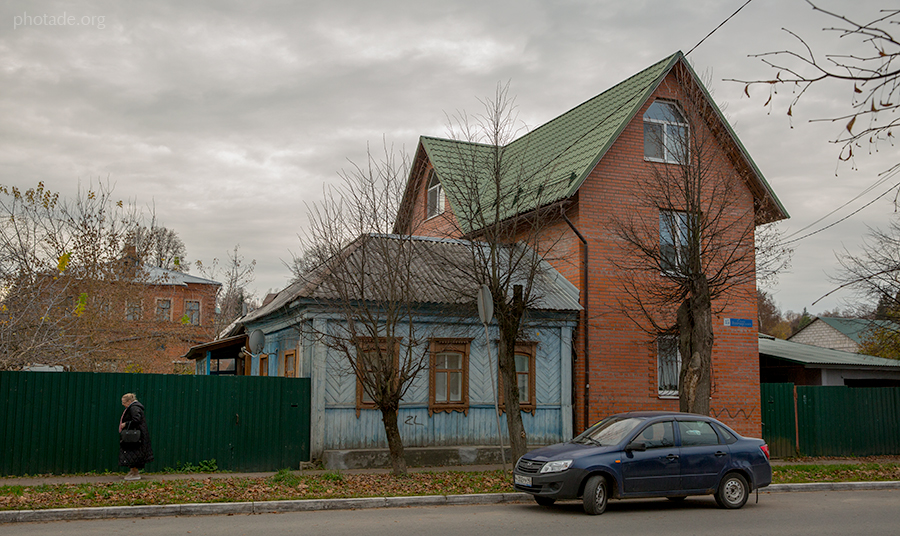 45. Этот дом привлёк наше внимание своей необычной конструкцией. Голубая часть слева старая, советского периода. Возможно, речь идёт об очень ранней постройке. Кирпичная часть справа новая и демонстрирует пример, как можно расширить старый дом, не вступая в спор с местными властями. Выглядит на самом деле, как два дома. Возможно, это пример того, что в одном доме было две квартиры, и одну половину снесли, чтобы вместо неё построить полноценное жильё. В любом случае, вне зависимости от того, какая у этого дома история, выглядит он предельно нелепо. This house attracted our attention with its unusual construction. The blue part on the left is old, from the Soviet period. Perhaps it is a very early building. The brick part on the right is new and demonstrates an example of how one can expand an old house without getting into a dispute with the local authorities. It actually looks like two houses. Perhaps this is an example of the fact that there were two apartments in one house, and one half was demolished to build full-fledged housing in its place. In any case, regardless of what history this house has, it looks extremely absurd. |
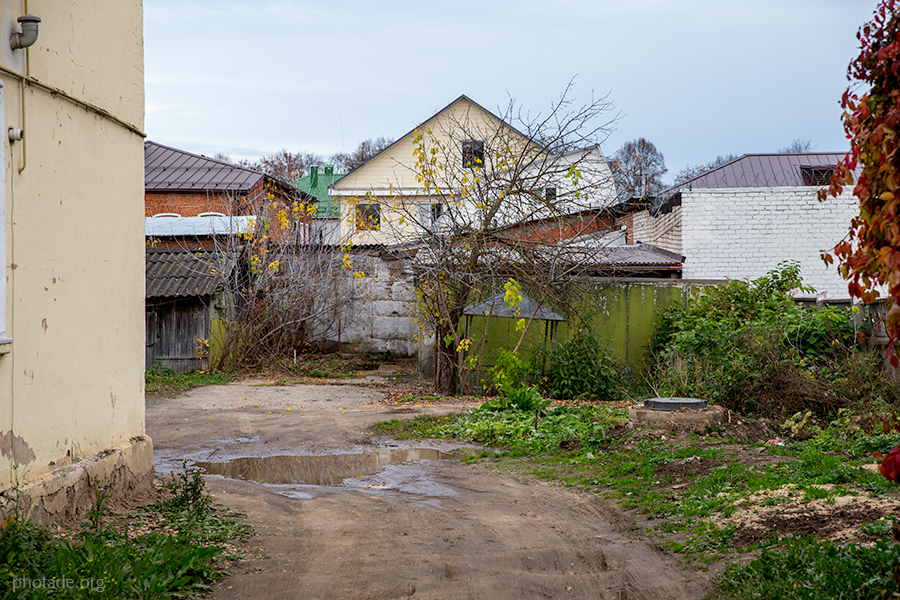 46. Взгляд в подворотню. И там ― ничего нового: косматые нестриженные кусты и лужи в грунтовых накатах. Ну, и покосившиеся хозяйственные постройки, конечно же. Классика. A look into the archway. And there — nothing new: shaggy unpruned bushes and puddles in dirt tracks. Well, and crooked utility buildings, of course. Russian Classic. |
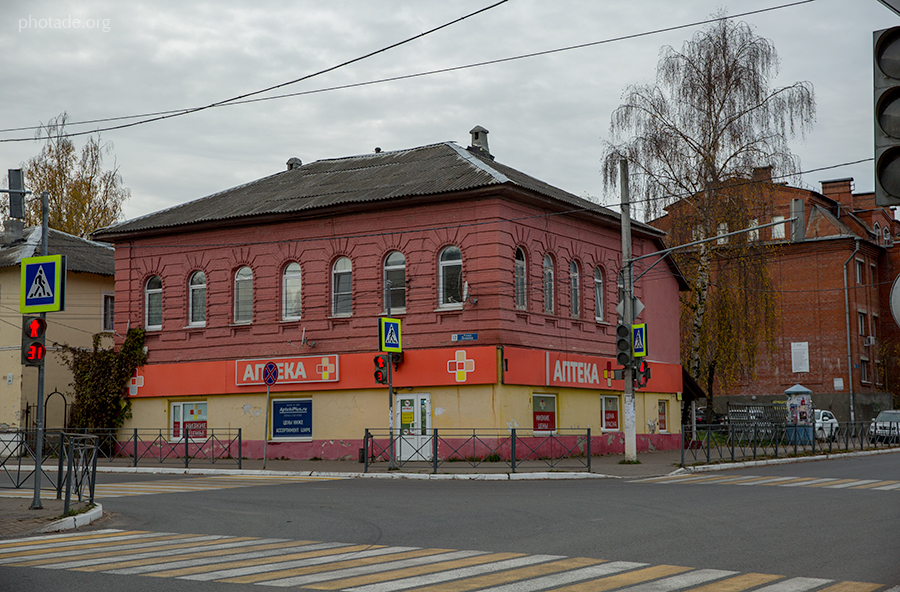 47. Пример исторической застройки какого-то в прошлом очень богатого жителя. Богатого, потому что кирпичи были очень дорогими, а у этого человека хватило денег на то, чтобы два этажа сделать кирпичными. Тут когда-то давно явно жили какие-то очень непростые люди. Кстати, справа следом видно ещё одно непростое здание, у него 4 этажа (3 стандартных и 4-ый как бы надстроенный), что нетипично для Тарусы. Здание похоже на историческое, но оно построено в 1999 году (источник). An example of the historical building of some very rich resident in the past. Rich, because bricks were very expensive, and this people had enough money to make two storeys brick. Here once long ago clearly lived some very not ordinary people. By the way, on the right, following it, another not simple building is visible; it has 4 storeys (3 standard and the 4th as if added on top), which is atypical for Tarusa. The building looks historical, but it was built in 1999 (source). |
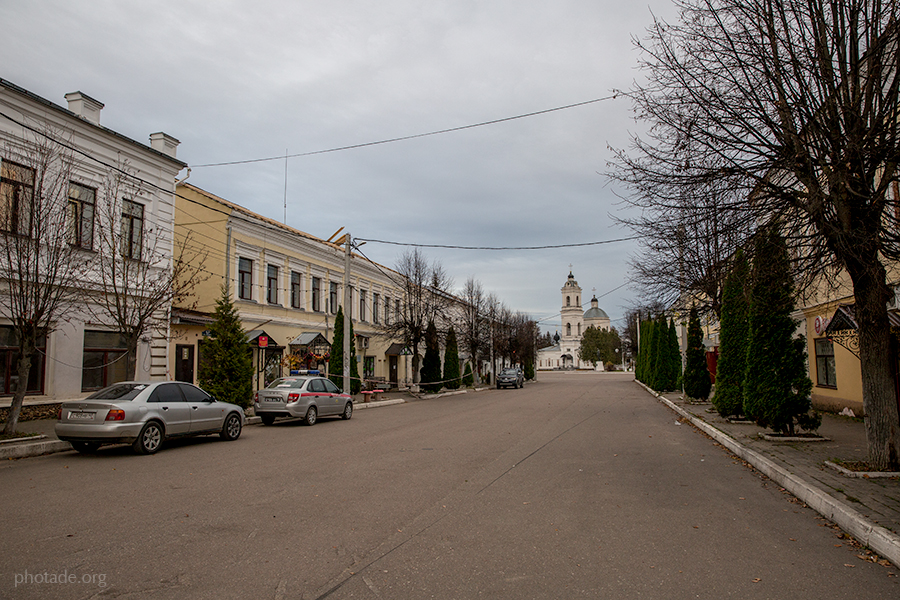 48. Вид с улицы Ленина на Петропавловский собор (он же Собор Святых Петра и Павла). Улица выглядит пустынной, потому что рабочий день ещё не закончился, да и большинство туристов ещё не приехало. A view from Lenin Street to the Peter and Paul Cathedral (also known as the Cathedral of Saints Peter and Paul). The street looks deserted because the working day is not yet over, and most tourists have not yet arrived. |
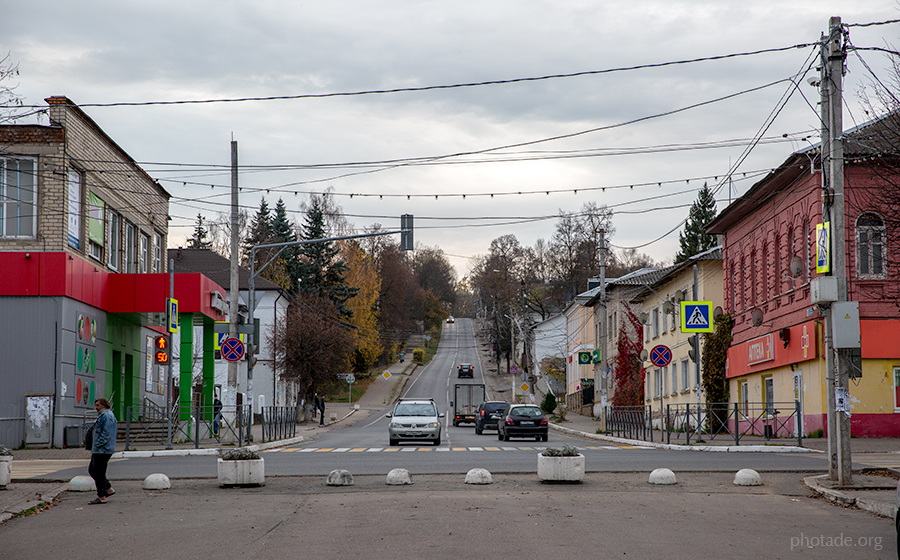 49. Перекрёсток на улице Ленина. Со светофором, так как это часть трассы, но есть у него один минус: зелёный свет для пешеходов сопровождается очень неприятным пиликаньем. Кто рядом живёт или работает, наверное, с ума сходит от этого бесконечного пищания. An intersection on Lenin Street. With a traffic light, since it is part of the highway, but it has one drawback: the green light for pedestrians is accompanied by a very unpleasant beeping. Those who live or work nearby probably go crazy from this endless beeping. |
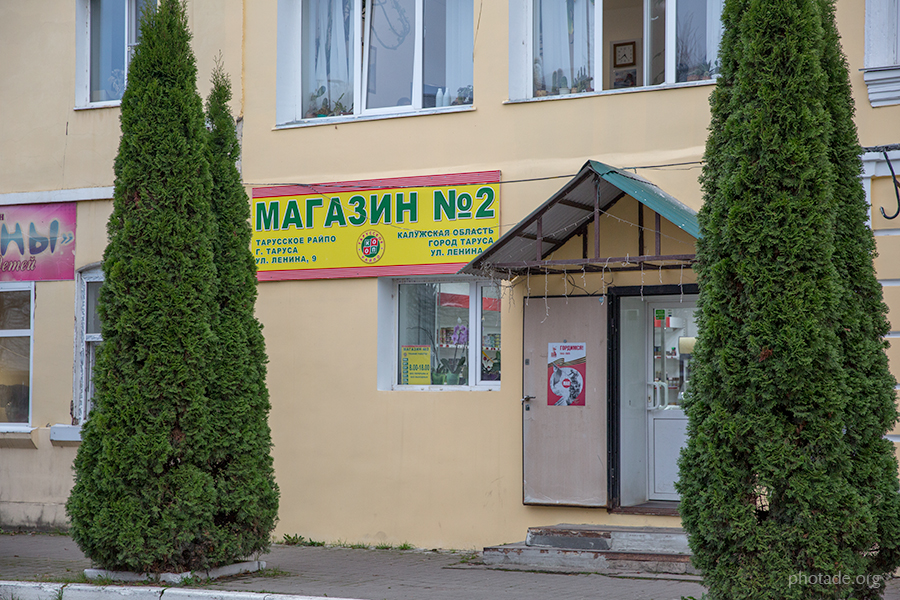 50. А здесь мы видим пример местной кооперации: магазинчик районного потребительского общества. В Тарусе есть кооператоры, и это сам по себе хорошо. Here we see an example of local cooperation: a small shop of the district consumer society. There are cooperators in Tarusa, and this is good in itself. |
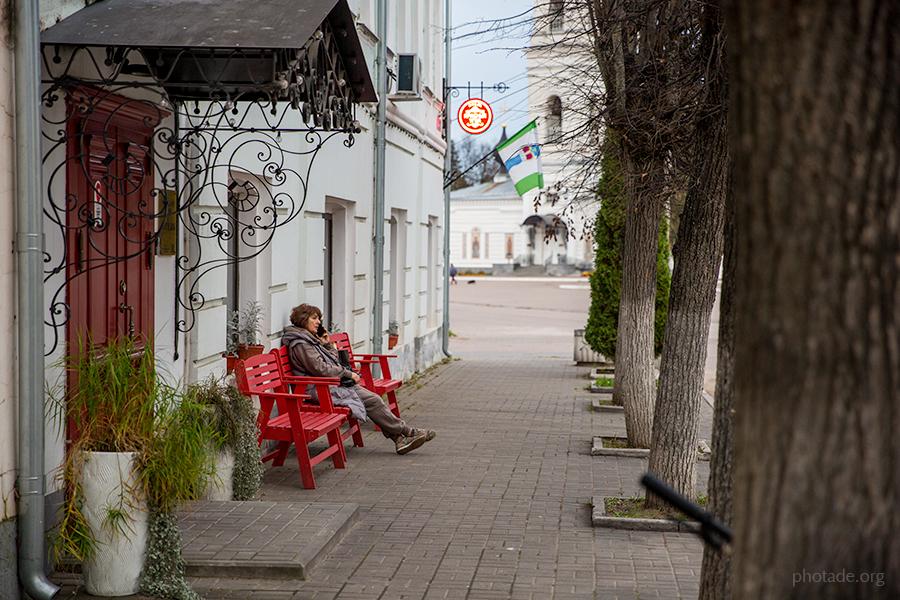 51. Тарусский вайб. На здании виднеется флаг Тарусского района (отличается от флага Тарусы зелёными полями по краям). Tarusa vibe. On the building, the flag of Tarussky District is visible (it differs from the flag of Tarusa by the green fields along the edges). |
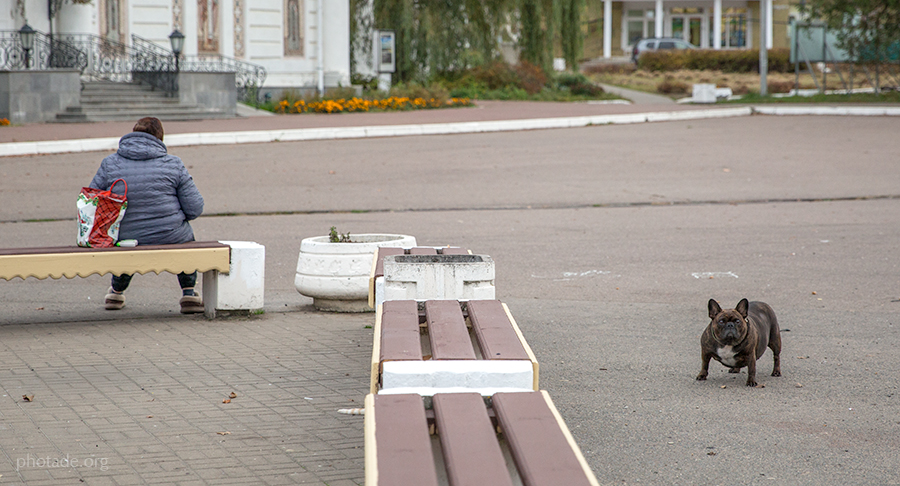 52. Откормленный французский бульдог на Соборной площади. A well-fed French bulldog on Cathedral Square. |
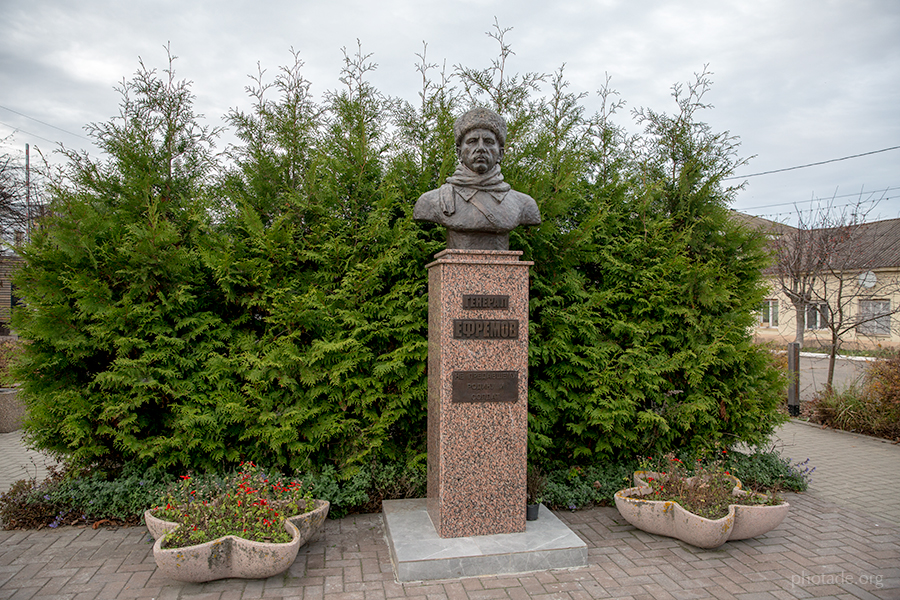 53. Памятник генералу М.Г. Ефремову, герою ВОВ и уроженцу Тарусы. Я бы сказала, что это одно из лучших оформлений памятников, что я видела. A monument to General M.G. Yefremov, a hero of the Great Patriotic War, born in Tarusa. I would say that this is one of the best designs of monuments that I have seen. |
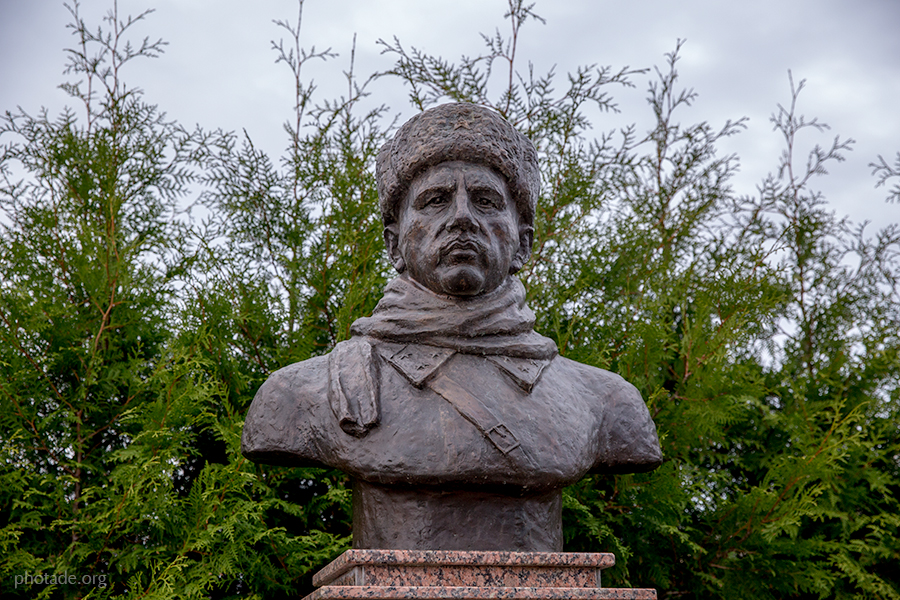 54. Михаил Григорьевич явил пример стойкого мужества, погиб, не сдаваясь, из-за чего немцы его даже похоронили с почестями. Интересная была личность. Автор ― Александр Казачок. У этого памятника, кстати, весьма мистическая история создания: идея этого образа пришла автору... во сне (источник). Этот образ показывает нам человека, готового умереть для мира ― скульптуру сделали с его последней фотографии незадолго до гибели. Сильная история, советую ознакомиться с подробностями в источнике. Mikhail Grigoryevich showed an example of steadfast courage; he died without surrendering, which is why the Germans even buried him with honors. An interesting personality. The author is Alexander Kazachok. By the way, this monument has a very mystical story of creation: the idea of this image came to the author... in a dream (source). This image shows us a man ready to die to the world — the sculpture was made from his last photograph shortly before his death. A powerful story; I recommend reading the details in the source. |
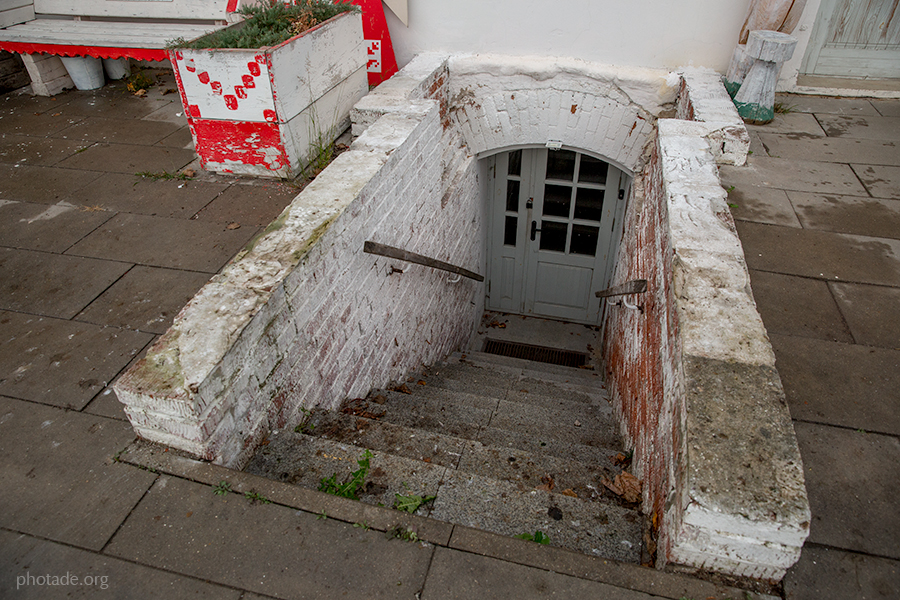 55. Чего точно в Тарусе нет ― это «закопанных домов». Все дома нормальной этажности, культурный слой минимальный. А этот вход ведёт в обычный подвал. What Tarusa definitely does not have is “buried houses”. All houses are of normal height, the cultural layer is minimal. And this entrance leads to an ordinary basement. |
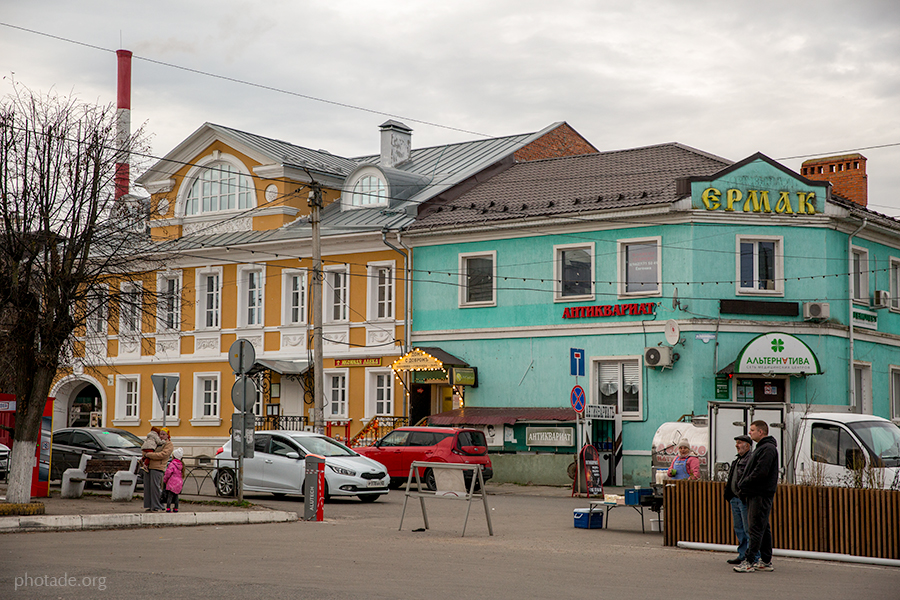 56. Старинные особняки, переделанные под современные торговые нужды. Old mansions converted for modern commercial needs. |
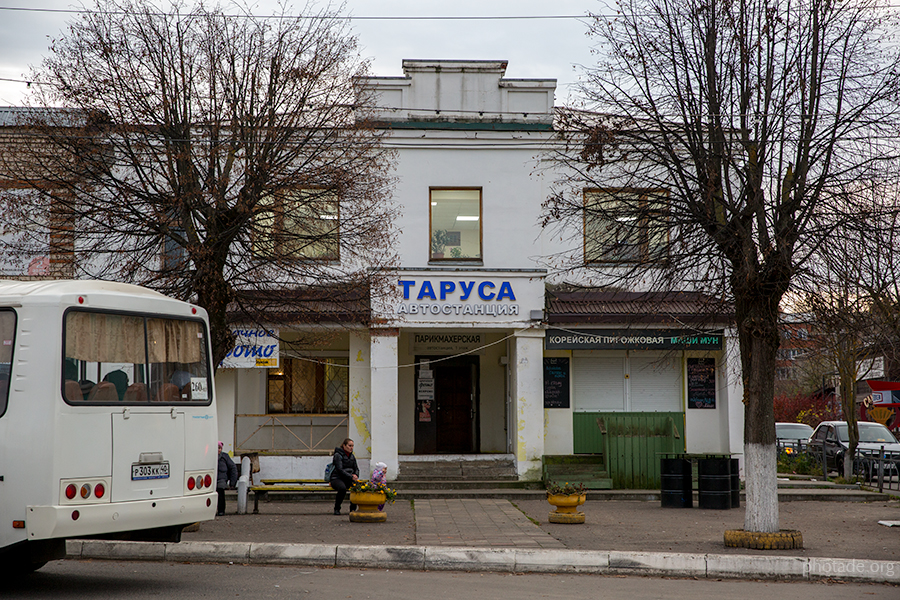 57. Автобусная автостанция ― связь города с миром. У Тарусы прямое автобусное сообщение с Калугой, Москвой и Серпуховым. Разумеется, по соседним деревенькам автобусы тоже людей развозят. Ближайшая железнодорожная станция находится в Серпухове, это примерно 35 км. Забавно, но станция Тарусская по прямой находится в примерно 14 км, но это Тульская область и прямой дороги туда нет. Если же всё-таки из Тарусы надо будет поехать на эту станцию, то ехать придётся через Серпухов (и это будет примерно 65 км), в котором свой нормальный ж/д вокзал. Короче, ж/д станция Тарусская к городу Тарусе реально никакого отношения не имеет. The bus station — the town's connection with the world. Tarusa has direct bus service with Kaluga, Moscow and Serpukhov. Naturally, the buses also carry people to the neighboring villages. The nearest railway station is located in Serpukhov, about 35 km away. It is funny, but the Tarusskaya station is about 14 km away in a straight line, but that is Tula Oblast and there is no direct road there. If, after all, one needs to go from Tarusa to that station, one will have to travel via Serpukhov (and that will be about 65 km), which has its own normal railway station. In short, the Tarusskaya railway station really has no relation to the town of Tarusa. |
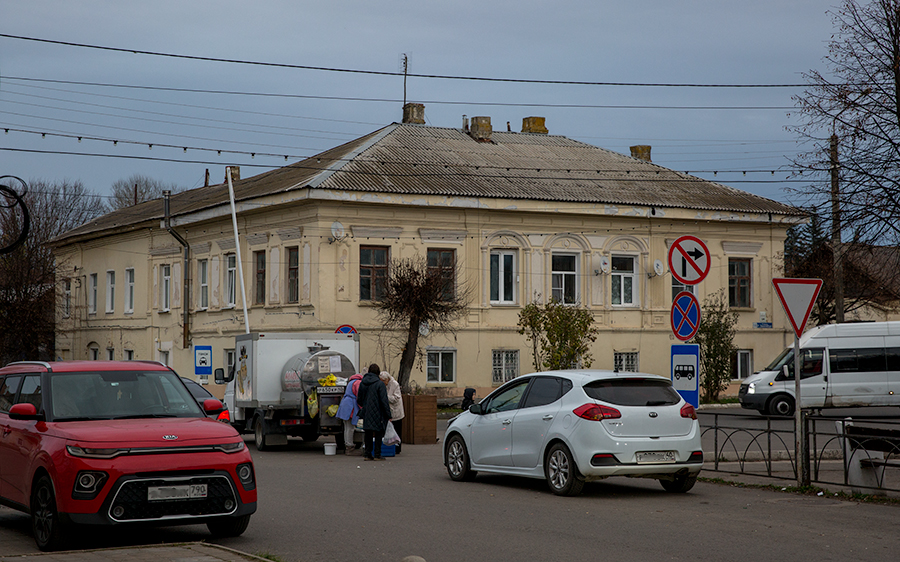 58. Историческое здание на углу улиц Комсомольской и Розы Люксембург. Historical building on the corner of Komsomolskaya and Rosa Luxemburg streets. |
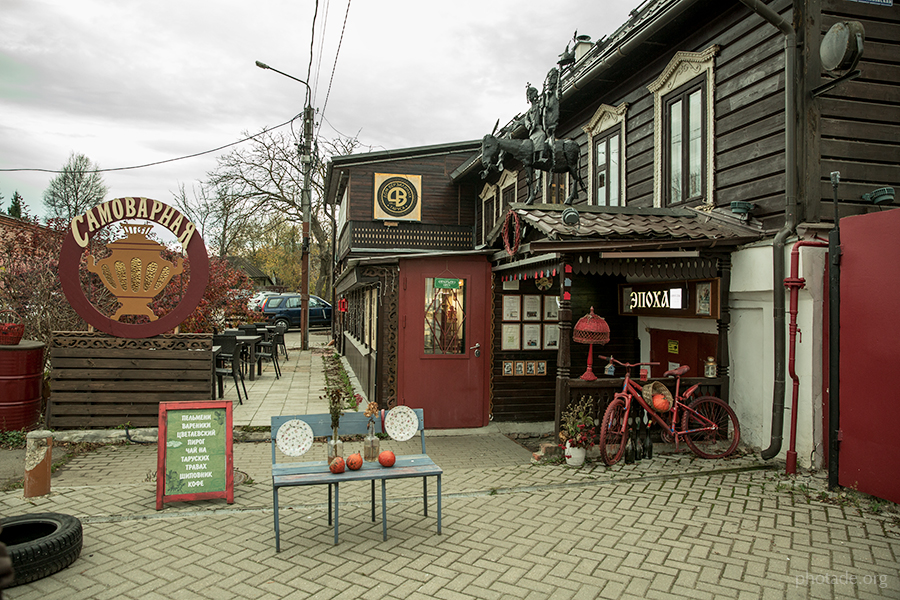 59. Культурный центр «Дом Верзилиных». Верзилины ― непростая фамилия в истории города. Они сами себя называют представителями современного купечества (что бы это ни значило, источник). Т.е. это наши современники, которые взяли на себя роль хранителей и популяризаторов современной культуры Тарусы. На данном фото мы видим отреставрированный дом 1904-го года, который принадлежал последнему голове Тарусы купцу И.Д. Макаренко. Слева вывеска «Эпоха» зовёт в антикварный магазинчик. Cultural center "House of the Verzilins". Verzilin is a not ordinary surname in the history of the town. They call themselves representatives of modern merchantry (whatever that means, source). That is, these are our contemporaries who have taken on the role of guardians and popularizers of modern culture of Tarusa. In this photo we see the restored house of 1904, which belonged to the last head of Tarusa, merchant I.D. Makarenko. On the left, the sign "Epoch" invites one into a small antique shop. |
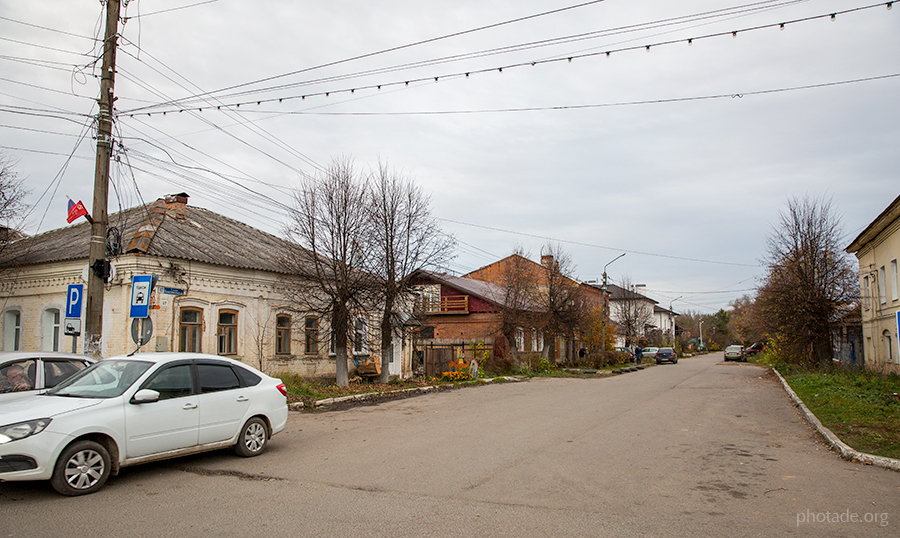 60. Комсомольская улица. В это трудно поверить (наверное), но это в самом центре города. До Петропавловского собора буквально 100 м. Кстати, в самом крайнем домике слева расположена неформальная арт-галерея «Рыжий кот». Здесь плохо видно, но между деревьями виднеется скамейка, на которой можно сфотографироваться с рыжим котом. В самой галерее выставляются работы местных художников. Komsomolskaya Street. It is hard to believe (probably), but this is in the very center of the town. It is literally 100 m to the Peter and Paul Cathedral. By the way, in the very last little house on the left is located the informal art gallery "Red Cat". Here it is poorly visible, but between the trees a bench is visible, on which one can take a photo with a red cat. In the gallery itself, the works of local artists are exhibited. |
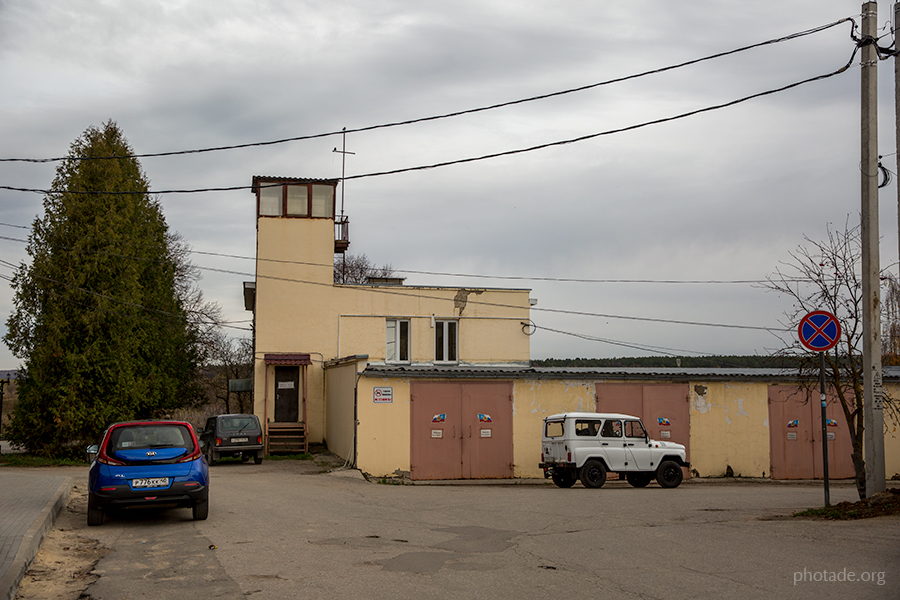 61. Здесь располагается Государственная инспекция по маломерным судам (ГИМС) МЧС РФ. Около ворот парковаться нельзя, но УАЗик явно принадлежит сотрудникам. УАЗиков в городе, кстати, много, что не удивительно для страны с плохими дорогами, в которой ты непременно с этим столкнёшься, стоит лишь съехать с федеральной трассы. Here is located the State Inspectorate for Small Vessels (GIMS) of the Ministry of Emergency Situations of the Russian Federation. It is not allowed to park near the gate, but the UAZ clearly belongs to the employees. There are many UAZs in the town, by the way, which is not surprising for a country with bad roads, in which you will certainly encounter this as soon as you turn off the federal highway. |
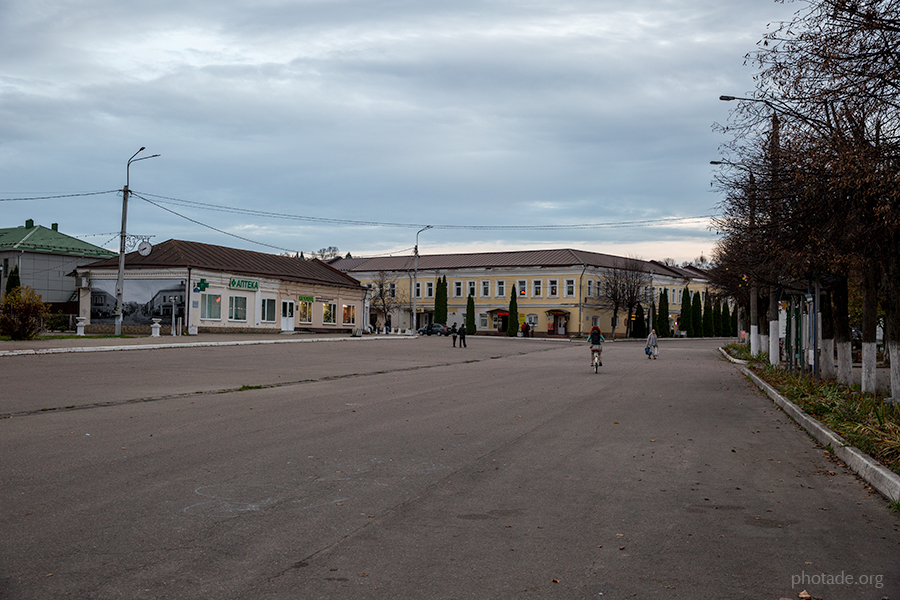 62. Вечерняя суета на площади Ленина. На самом деле это сейчас пусто, а в прошлом эта улица была предназначена для ярмарки (посмотреть, как это было, можно, например, здесь). Не знаю, поддерживают ли сейчас эту традицию хотя бы по выходным или каким-либо датам, но место явно зря пустует. Evening bustle on Lenin Square. In fact, it is empty now, but in the past this street was intended for a fair (one can see how it was, for example, here). I do not know whether this tradition is maintained now at least on weekends or on some dates, but the place is clearly empty in vain. |
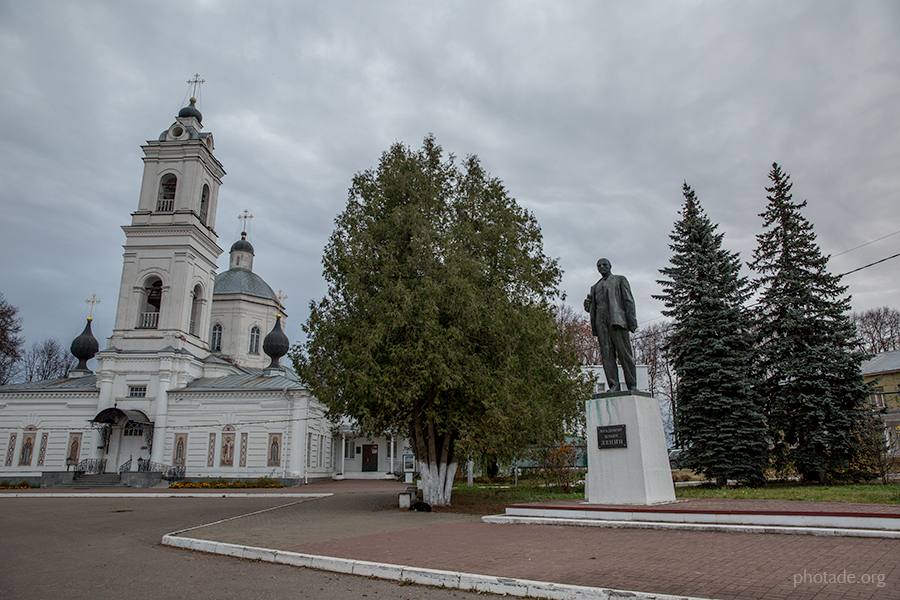 63. Две центральные доминанты: Собор и Ильич. Как говорится, и нашим, и вашим. Two central dominants: the Cathedral and Ilyich. As they say, to both ours and yours. |
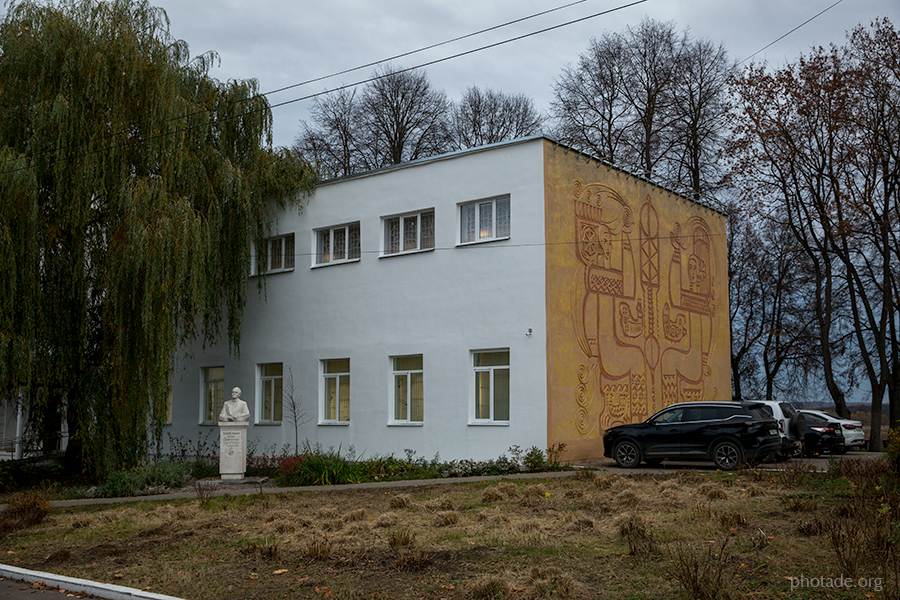 64. Здание картинной галереи города Тарусы, художественный музей. Представлены как постоянная экспозиция, так и временные выставки. Слева белый памятник Святославу Рихтеру, чьё имя для Тарусы тоже очень значимо. Чуть правее от центра на торце здания виднеется панно-сграффито (техника рельефной штукатурки) под названием «Тарусская вышивка» (также известное как «Пряхи»), авторство неизвестно. Здание возведено в 1967 году. По сути очередная скучная советская «коробка», поэтому панно этот дом хоть как-то украшает. The building of the art gallery of the town of Tarusa, an art museum. Both a permanent exhibition and temporary exhibitions are presented. On the left is a white monument to Svyatoslav Richter, whose name is also very significant for Tarusa. Slightly to the right of the center, on the end wall of the building, a sgraffito panel (a technique of relief plaster) titled "Tarusa Embroidery" (also known as "Spinners") is visible; the authorship is unknown. The building was erected in 1967. In essence, another boring Soviet "box", which is why the sgraffito at least somehow decorates this house. |
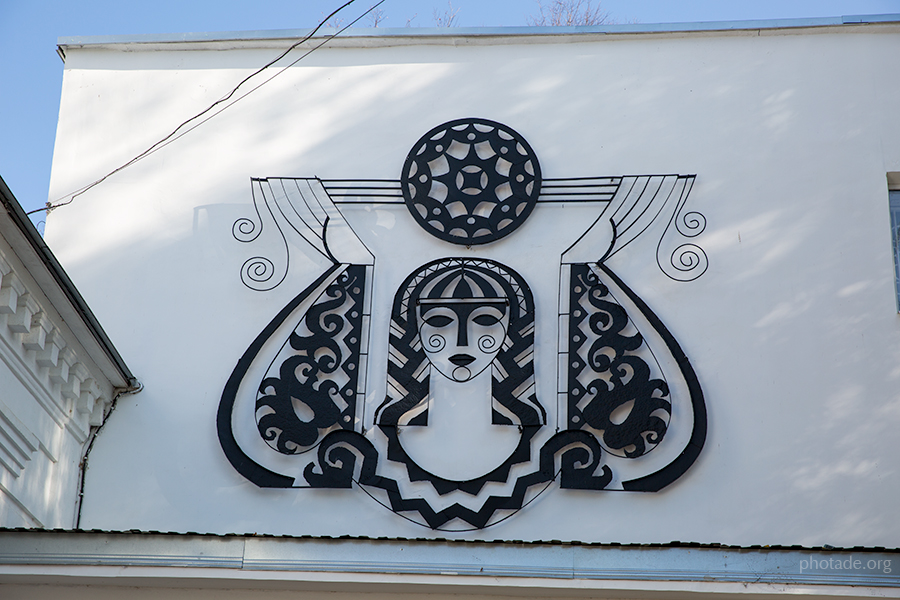 65. Металлическое панно, также повторяющее мотивы тарусской вышивки, над входом в художественную галерею. Авторство также неизвестно. Выполнено в технике чеканки по металлу. A metal panel, also repeating the motifs of Tarusa embroidery, above the entrance to the art gallery. The authorship is also unknown. Made in the technique of metal chasing. |
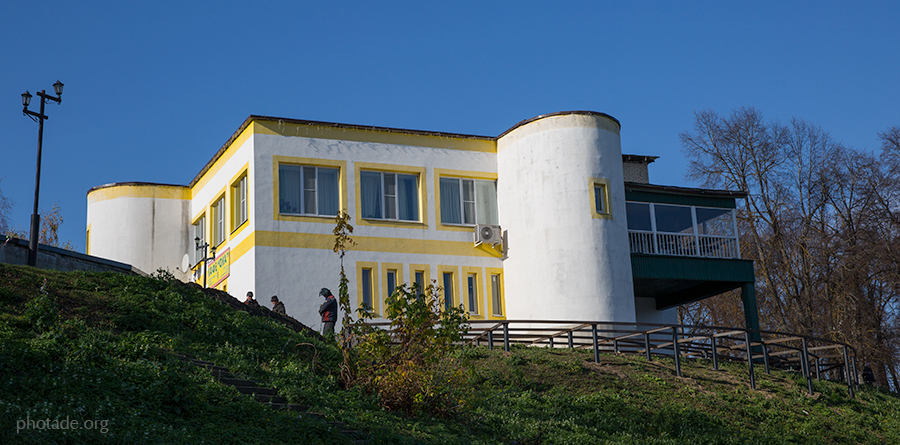 66. Кафе «Ока», заметно облагороженное, если судить по фотографиями последних лет. На фото видно продолжение реконструкции: строят дополнительную веранду, которая явно будет очень актуальна в тёплое время года. Из окон кафе открываются чудесные виды на Оку и Тульскую область. Cafe "Oka", noticeably improved, judging by the photographs of recent years. In the photo, the continuation of the reconstruction is visible: an additional veranda is being built, which will clearly be very relevant in the warm season. From the windows of the cafe, wonderful views of the Oka and Tula Oblast open up. |
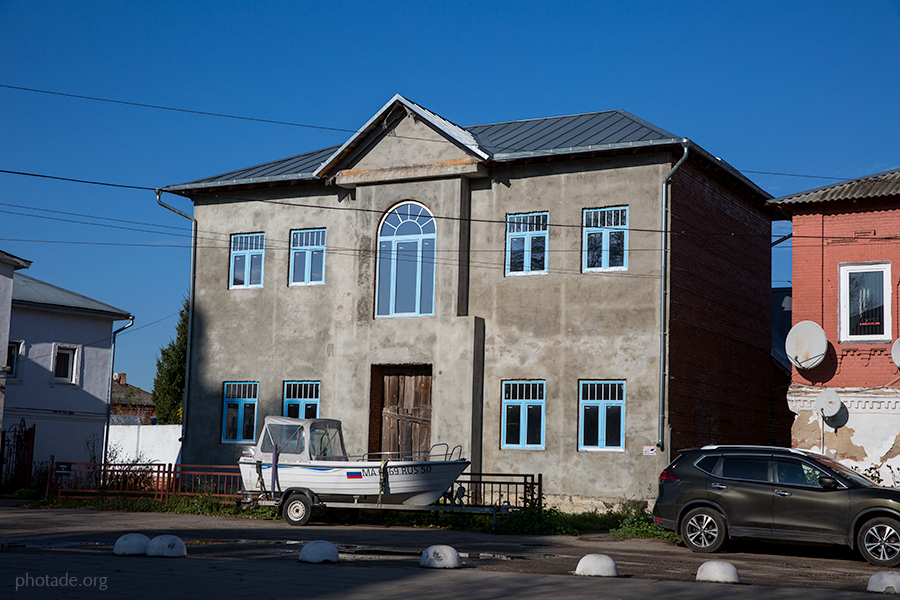 67. Домик, который то ли строят заново, то ли перестраивают. В любом случае, это самый центр, долго строение в таком виде явно не просуществует, тут обязательно будет что-нибудь либо уютное, либо интересное. A little house that is either being built anew or being rebuilt. In any case, this is the very center; a building in such a form clearly will not exist for long, here there will certainly be something either cozy or interesting. |
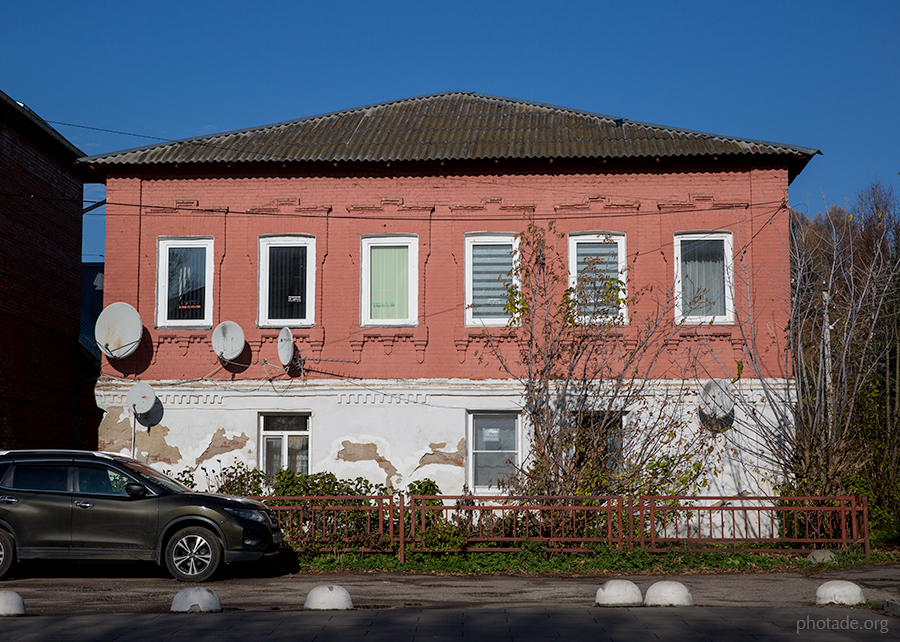 68. Постройка начала 20 века, источник говорит, что оно построено до 1920-х. Когда-то тут планировала жить зажиточная семья, но потом пришла советская власть и началось общежитие в буквальном смысле слова. Видимо, что-то с кармой у этого домика явно не задалось с самого начала (особенно если верить, что дата его постройки ― 1917-ый), сейчас здесь какая-то ночлежка для туристов. Место козырное, но, судя по фасаду, владельцам важнее деньги, а не создание благоприятного впечатления от посещения города. A building of the early 20th century; the source says that it was built before the 1920s. Once a well-to-do family planned to live here, but then Soviet power came and a dormitory in the literal sense of the word began. Apparently, something with the karma of this little house clearly did not work out from the very beginning (especially if one believes that the date of its construction is 1917); now there is some kind of cheap lodging house for tourists here. The spot is prime, but judging by the facade, the owners care more about money than about creating a favorable impression from visiting the town. |
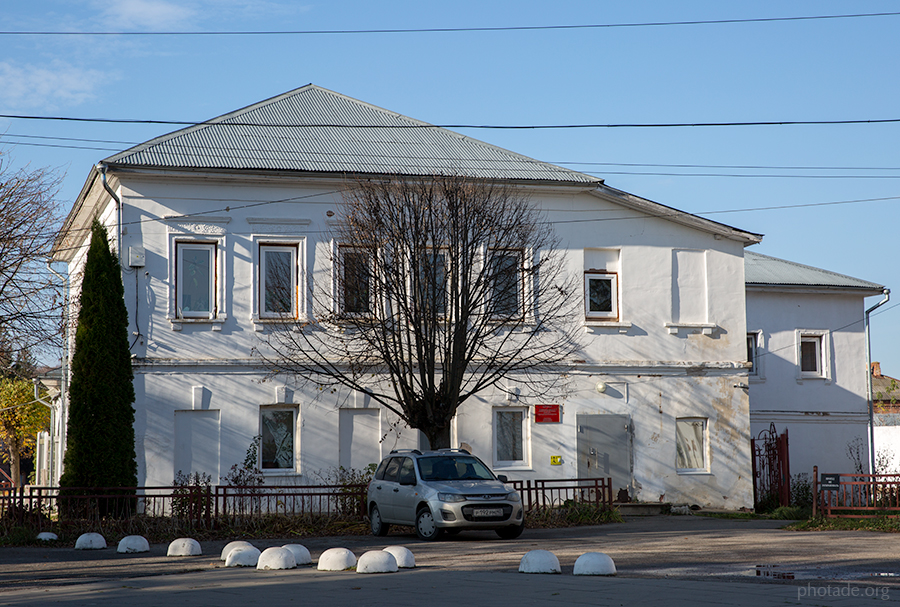 69. Ещё один образец архитектуры 19 века, раньше это был жилой дом (год постройки в открытых источниках отсутствует). Сейчас здесь расположена музыкальная школа, которая является филиалом Тарусской школы искусств, открытой в 1955 году. Когда мимо идёшь, слышны звуки музыкальных инструментов и голоса, обучающиеся пению. Это создаёт забавное впечатление, но все мы когда-то с чего-то начинали, поэтому смеяться тут не над чем ― напротив, хорошо, что тут дети учатся музыке. Это всегда прекрасно. Another example of 19th-century architecture; formerly it was a residential house (the year of construction is absent in open sources). Now here is located a music school, which is a branch of the Tarusa School of Arts, opened in 1955. When you walk past, the sounds of musical instruments and voices learning to sing are heard. This creates an amusing impression, but we all once started from something, so there is nothing to laugh at here — on the contrary, it is good that children here learn music. This is always wonderful. |
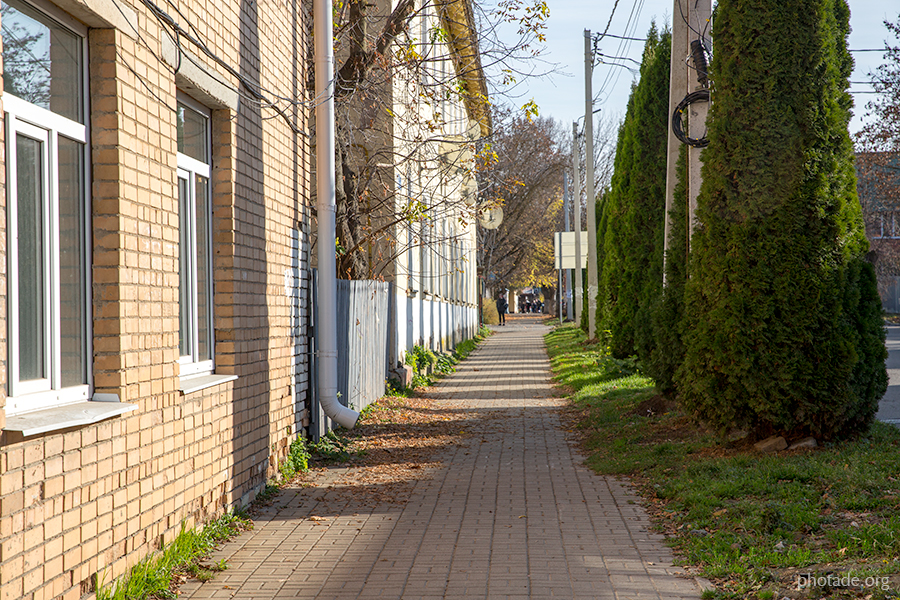 70. В целом, мы видим, что архитектура Тарусы скромна вне зависимости от периода застройки. Неважно, идёт ли речь о дореволюционных строениях, советских домах или постсоветских зданиях. В любом случае архитектура утилитарна. Суровый климат не позволяет расписывать скучные стены, да и в принципе краскам тяжело переживать русскую зиму. Поэтому внешний облик города спокойный. Никаких излишеств. Из-за чего творческие всплески в виде кованных украшений или сграффито мгновенно цепляют взгляд. При этом советская архитектура самая скучная ― это исключительно функционализм, преимущественно в силикатном кирпиче. Зато с декоративной функцией отлично справляются деревья и прочие растения. Летом город утопает в зелени, впрочем, и осень не подводит с яркими красками. Поэтому архитектура города ― лишь ненавязчивый фон, на котором разворачиваются подлинные истории местных жителей. In general, we see that the architecture of Tarusa is modest regardless of the period of development. It does not matter whether we are talking about pre-revolutionary buildings, Soviet houses or post-Soviet buildings. In any case, the architecture is utilitarian. The harsh climate does not allow painting boring walls, and in general it is hard for paints to survive the Russian winter. Therefore, the external appearance of the town is calm. No excesses. Because of this, creative outbursts in the form of forged decorations or sgraffito instantly catch the eye. At the same time, Soviet architecture is the most boring — it is exclusively functionalism, predominantly in silicate brick. But trees and other plants cope excellently with the decorative function. In summer the town is immersed in greenery; by the way, autumn does not let one down with bright colors either. Therefore, the architecture of the town is merely an unobtrusive background against which the genuine stories of local residents unfold. |
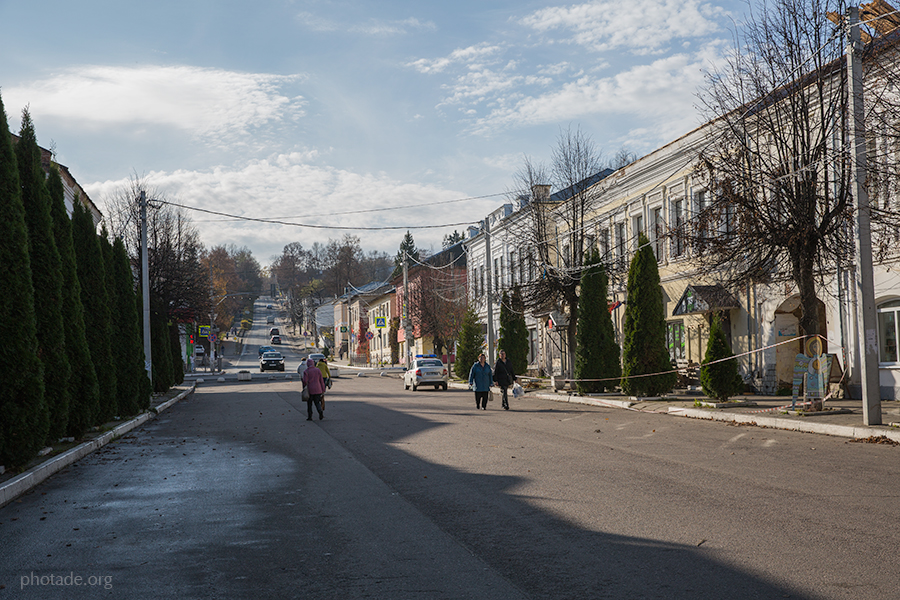 71. Собственно говоря, вот такой я увидела Тарусу в свой первый визит в этот город. Сейчас понимаю, что увидела далеко не всё, и очень многое осталось за кадром ― даже в рамках следующих галерей. Но для себя я уже решила, что ещё вернусь сюда, поэтому нет смысла в одну поездку пытаться объять необъятное. Этот городок как раз тем и хорош, что он оставляет поводы сюда вернуться. А вернуться сюда и впрямь есть зачем. As a matter of fact, this is how I saw Tarusa on my first visit to this town. Now I understand that I saw far from everything, and very much remained behind the scenes — even within the framework of the following galleries on this site. But I have already decided for myself that I will return here again, so there is no point in trying to embrace the unembraceable in one trip. This small town is good precisely because it leaves reasons to return here. And there is indeed something to return here for. |