 |
|
По современным меркам Таруса город маленький, поэтому религиозных строений тут немного. Однако эта часть городской жизни заслуживает самостоятельного рассказа, поэтому я выделила фотографии церквей в отдельную галерею. Заодно это повод немного поговорить о православной Тарусе. Правда, в городе есть протестантская община, но она зарегистрирована в конце 1990-х и находится в здании, не представляющем собой архитектурную ценность. Так что основная конфессия Тарусы ― это православие с очень небольшой примесью протестантов-пятидесятников. Храмы отражают важную часть жизни города: с одной стороны, это выражение духовности горожан, с другой ― это памятники архитектуры и истории. Как уже упоминалось ранее, Таруса город старый, с многовековой историей. В июле 2026 года здесь отпраздновали 780-летие: принято считать, что первое упоминание Тарусы было в 1246 году в Ипатьевской и Ермолинской летописи (источник). Знавал этот город и взлёты, и падения. В Средневековье город неоднократно сражался с крымскими татарами, потом в Смутное время пришёл в запустение. При Петре I началось возрождение города, при Екатерине II Таруса становится крупным купеческим центром. Как пишет уже упоминавшийся выше источник, в 1777 году Таруса получает свой герб, после чего её экономика буквально расцветает, появляются купеческие дома, каменные торговые ряды. Тарусские купцы доставляют свои товары в Москву и Санкт-Петербург, Нижний Новгород и Астрахань. Тарусский купец Иван Алтынников строит на главной площади города собор Петра и Павла, освящённый в 1790 году, который сохранился и поныне, открываются три ярмарки. Разумеется, такой город не может быть без церквей. И раньше их было больше, но не всем удалось пережить советское атеистическое время. Также не стоит забывать, что во время Великой Отечественной войны 1941-1945 гг. эти земли были частью театра военных действий, так что часть религиозных строений пострадала ещё и во время войны. Самой древней церковью Тарусы была Георгиевская церковь, которая ныне не сохранилась (источник). Находилась она на кладбище на реке Таруса. Из сохранившихся самая старая ― церковь Воскресения Христова на Воскресенском холме. Если посмотреть на современную карту Тарусы, то религиозных строений тут немного, и некоторые построены в относительно недавнее время. Как пишет сайт «Православная Таруса», когда-то на территории Тарусского района (в его нынешних границах) была 21 церковь, из них сохранилось всего 10, остальные были уничтожены в советское время. Ниже я расскажу о трёх самых значимых храмах Тарусы, но кому в принципе интересна история становления тарусской епархии, советую познакомиться с сайтом «Православная Таруса», там все значимые даты и события описаны. Как и всё в Тарусе, храмы в этом городе лишены помпезности. Это светлые основательные здания, точки притяжения внимания на панораме города. Собор Петра и Павла в принципе служит хорошим пространственным ориентиром во время прогулок по центру. Так что можно не принадлежать к православной вере, но не обратить внимания на эти строения в Тарусе невозможно.
* * *
By modern standards, Tarusa is a small town, therefore there are few religious buildings here. However, this part of town life deserves a separate story, so I have singled out the photos of churches into a separate gallery. At the same time, this is an occasion to talk a little about Orthodox Tarusa. True, there is a Protestant community in the town, but it was registered in the late 1990s and is located in a building that does not represent any architectural value. So the main confession of Tarusa is Orthodoxy with a very small admixture of Protestant Pentecostals. Churches reflect an important part of the town's life: on the one hand, this is an expression of the spirituality of the townspeople; on the other hand, they are monuments of architecture and history. As already mentioned earlier, Tarusa is an old town, with a centuries-old history. In July 2026, the 780th anniversary was celebrated here: it is customary to consider that the first mention of Tarusa was in 1246 in the Ipatiev and Ermolinsk chronicles (source). This town has known both ups and downs. In the Middle Ages, the town repeatedly fought with the Crimean Tatars, then during the Time of Troubles it fell into desolation. Under Peter I, the revival of the town began; under Catherine II, Tarusa becomes a major merchant center. As the already mentioned above source writes, in 1777 Tarusa receives its coat of arms, after which its economy literally blossoms, merchant houses and stone Trading Rows appear. Tarusa merchants deliver their goods to Moscow and St. Petersburg, Nizhny Novgorod and Astrakhan. Tarusa merchant Ivan Altynnikov builds on the main square of the town the Cathedral of Peter and Paul, consecrated in 1790, which has survived to our day; three fairs are opened. Of course, such a town cannot be without churches. And earlier there were more of them, but not all managed to survive the Soviet atheistic time. Also, we should not forget that during the Great Patriotic War of 1941-1945 these lands were part of the theater of military operations, so some religious buildings suffered during the war. The oldest church in Tarusa was the St. George Church, which has not survived to this day (source). It was located at the cemetery on the Tarusa River. Of the surviving ones, the oldest is the Church of the Resurrection of Christ on the Resurrection Hill. If you look at a modern map of Tarusa, there are few religious buildings here, and some were built in relatively recent times. As the website "Orthodox Tarusa" writes, once on the territory of Tarussky District (within its present borders) there were 21 churches, of which only 10 have survived; the rest were destroyed in Soviet times. Below I will tell about the three most significant churches of Tarusa, but to anyone who is generally interested in the history of the formation of the Tarusa eparchy, I advise to get acquainted with the website "Orthodox Tarusa"; all significant dates and events are described there. Like everything in Tarusa, the churches in this town are devoid of pomp. These are light, solid buildings, points of interest in the town panorama. The Cathedral of Peter and Paul in principle serves as a good spatial landmark during walks in the center. So you may not belong to the Orthodox faith, but it is impossible not to notice these buildings in Tarusa.
2026
|
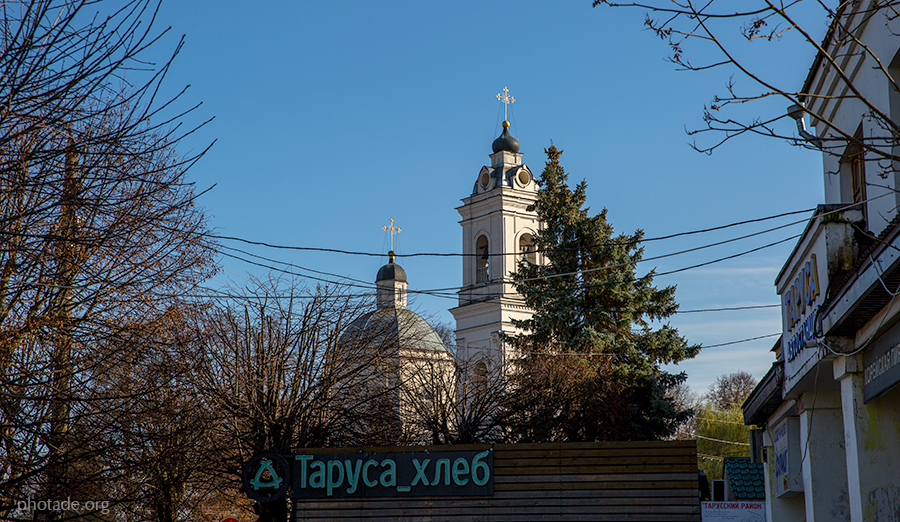 1. Вид на собор Петра и Павла от автовокзала. По сути этот храм ― первое, что обращает на себя внимание любого приезжего, причём, неважно, автотранспортом или по Оке. View of the Cathedral of Peter and Paul from the bus station. In essence, this church is the first thing that attracts the attention of any traveler, and it does not matter whether by motor transport or along the Oka. |
|
Собор Святых Петра и Павла The Cathedral of Saints Peter and Paul |
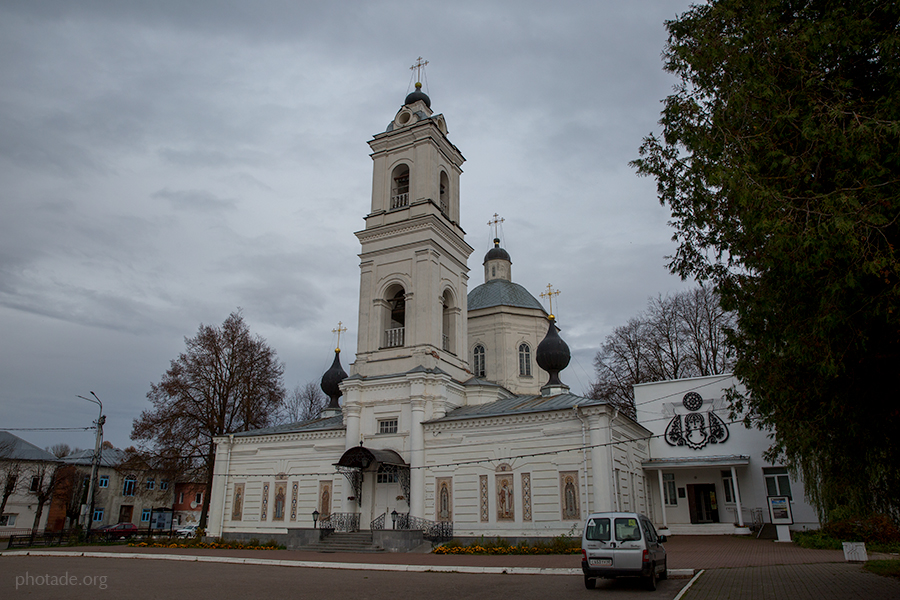 2. Главный храм Тарусы. Построен в самом конце 18 века, год основания ― 1789 (источник). В своём первоначальном виде до нас не дошёл, на фото мы видим уже восстановленную версию (заново построили колокольню, например). В первоначальной версии не было приделов, они появились позднее (источник). В советское время службы здесь проводились до 1933 года. Но потом собор закрыли, колонну разрушили, а на том месте, где сейчас стоит памятник Ленину, разожгли костёр, в котором сожгли церковные книги и утварь со всего Тарусского уезда. В 1936 году из храма сделали дом пионеров. Во время войны фашисты здесь открывали временную церковь (источник), но после войны советская власть снова решительно её закрыла. После развала СССР верующим храм вернули не сразу, хотя активисты подавали заявки несколько раз. В итоге первый молебен в постсоветский период случился в храме только в 2001 году. Реконструкция собора была произведена в период с 1998 по 2009 год. Отреставрировали хорошо, добротно, с красивыми мозаиками, без вычурности. Радует, что есть пандус для колясок (на фото видно справа от крыльца), такое не часто увидишь в наших храмах. The main church of Tarusa. Built at the very end of the 18th century; the year of foundation is 1789 (source). It has not come down to us in its original form; in the photo we see an already restored version (the bell tower was rebuilt, for example). In the original version there were no side chapels; they appeared later (source). In Soviet times, services here were held until 1933. But then the cathedral was closed, the bell tower was destroyed, and on the spot where the monument to Lenin now stands, a bonfire was lit in which church books and utensils from all over Tarussky Uyezd were burned. In 1936 the church was turned into a House of Pioneers. During the war, the Nazis opened a temporary church here (source), but after the war the Soviet authorities decisively closed it again. After the collapse of the USSR, the church was not returned to the believers immediately, although activists submitted applications several times. As a result, the first prayer service in the post-Soviet period took place in the church only in 2001. The reconstruction of the cathedral was carried out between 1998 and 2009. It was restored well, solidly, with beautiful mosaics, without pretentiousness. It is pleasing that there is a ramp for strollers (visible in the photo to the right of the porch); such a thing is not often seen in Russian churches. |
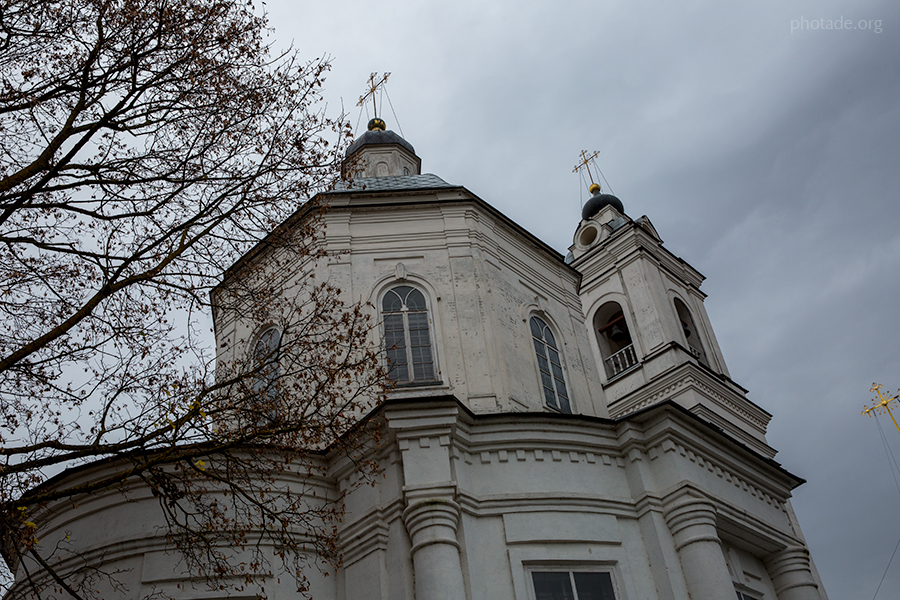 3. Собор ― главная архитектурная доминанта города. Надстроенная часть отличается по цвету от сохранившейся. Архитектором первоначального проекта был И.Д. Ясныгин, он был губернским архитектором Калуги и Чернигова, в 1770-х годах успел поработать под руководством В.И. Баженова, а также в Чернигове он поработал над проектом Кваренги. Очень талантливый архитектор, который отметился многими замечательными зданиями в Калуге и её окрестностях. Поэтому в облике этого храма чувствуется уверенная рука классического мастера, который тонко владеет своим искусством. Хотя тут стоит отметить, что архитектура храма не является классицизмом в полной мере, так как он был построен в переходную эпоху. Деньги на строительство храма дала Екатерина II, а в её правление царило барокко. А выше мы уже отметили, что архитектор Ясныгин всё-таки наследник классицизма. Поэтому Петропавловский собор — это памятник переходного времени, в облике которого причудливо переплелись уходящее барокко (в декоре и общей живописной массе) и нарождающийся классицизм (в общей структуре и плановом решении). The cathedral is the main architectural dominant of the town. The added upper part differs in color from the surviving one. The architect of the original project was I.D. Yasnygin; he was the provincial architect of Kaluga and Chernigov, in the 1770s he managed to work under the guidance of V.I. Bazhenov, and also in Chernigov he worked on a project by Quarenghi. A very talented architect who left his mark with many remarkable buildings in Kaluga and its surroundings. Therefore, in the appearance of this church one feels the confident hand of a classical master who subtly masters his art. Although it is worth noting here that the architecture of the church is not classicism in full measure, since it was built in a transitional era. The money for the construction of the church was given by Catherine II, and during her reign baroque prevailed. And above we have already noted that the architect Yasnygin is an heir of classicism. Therefore, the Cathedral of Peter and Paul is a monument of a transitional time, in whose appearance the departing baroque (in the decor and general picturesque mass) and the nascent classicism (in the general structure and planning solution) are whimsically intertwined. |
|
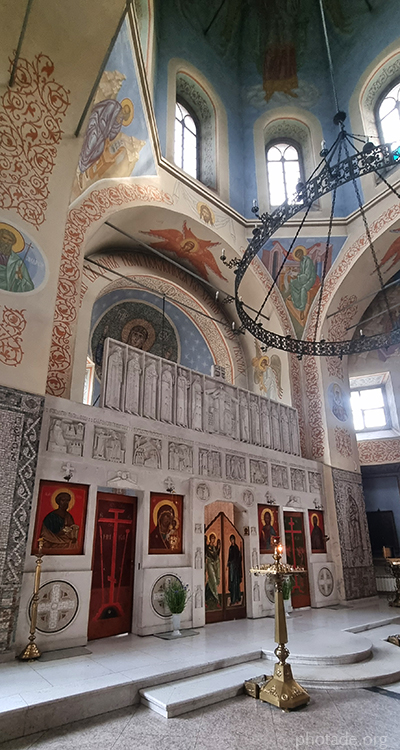
4. Внутреннее убранство храма. Посетителей тут среди дня немного, но в храм люди идут. На стенах не только красивые росписи, но и мозаики в византийском стиле, правда, всё это убранство появилось только после восстановления. Также здесь мы видим, что высокие арочные окна (в том числе в барабане купола) делают храм очень светлым. В целом, храм тихий и очень уютный. The interior decoration of the cathedral. There are few visitors here during the day, but people do come to this church. On the walls there are not only beautiful murals but also mosaics in the Byzantine style; however, all this decoration appeared only after the restoration. Here we also see that the tall arched windows (including those in the drum of the dome) make the cathedral very bright. Overall, the temple is quiet and very cozy. |
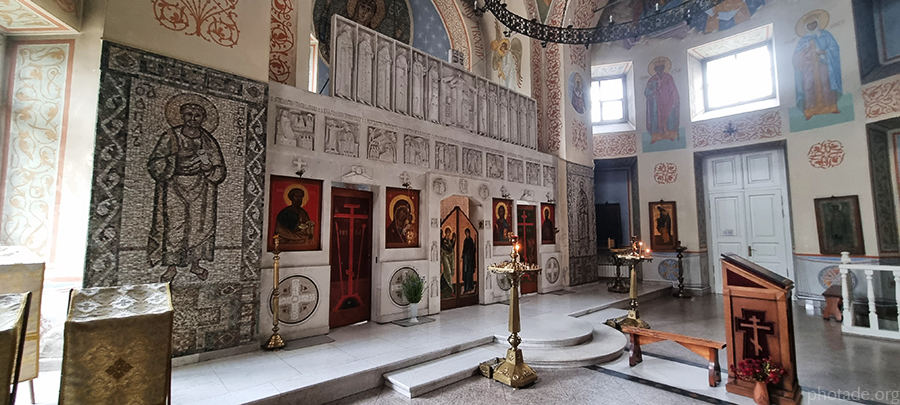 5. Каменный иконостас появился в этом храме после реставрации 1998-2009 гг. Автор иконостаса Анатолий Комелин (источник). Такой иконостас ― совсем нетипичное явление для русских православных храмов. Здесь можно почитать про праздники на этом иконостасе (а здесь можно подробнее посмотреть изображения). Интересно, но в этом храме очень много старых икон, некоторые очень интересные, есть довольно редко встречающиеся образы. И в целом внутри храм будто состоит из трёх церквей (благодаря двум приделам), каждый из которых имеет свой стиль и своё духовное настроение. A stone iconostasis appeared in this cathedral after the restoration of 1998–2009. The author of the iconostasis is Anatoly Komelin (source). Such an iconostasis is a rather atypical phenomenon for Russian Orthodox churches. Here you can read about the feasts depicted on this iconostasis (and here you can look at the images in more detail). It is fascinating that this cathedral has a lot of old icons, some of which are very interesting, and there are some rather rare images. Overall, the interior of the cathedral seems to consist of three churches (thanks to the two side chapels), each with its own style and spiritual mood. |
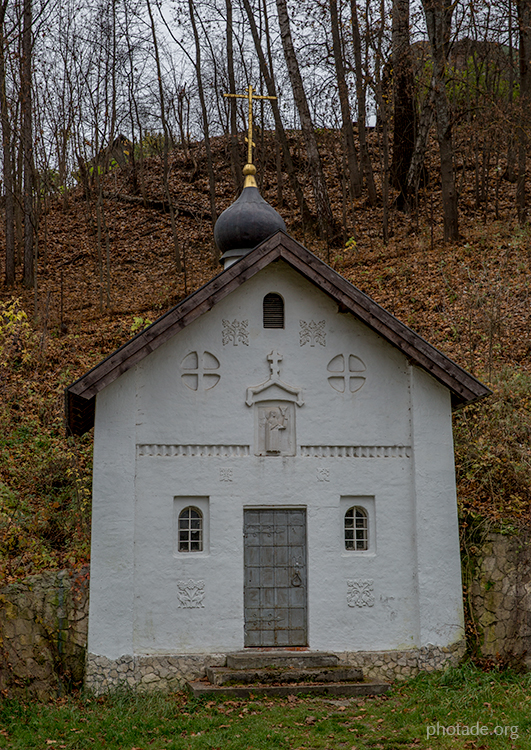
|
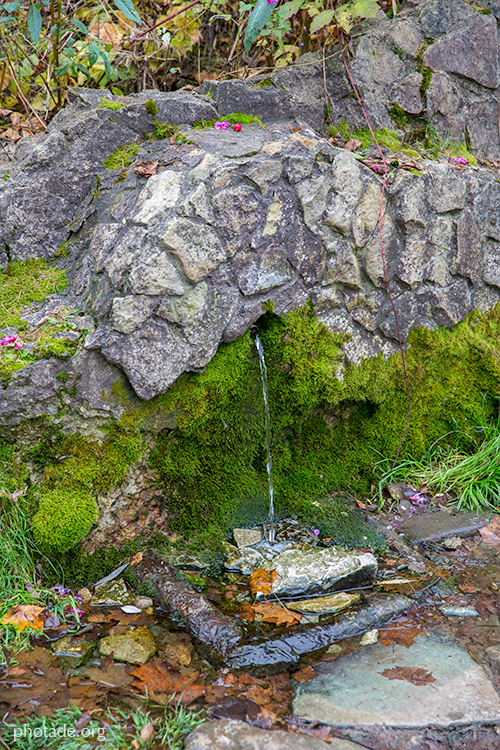
Церковь Воскресения Христова Church of the Resurrection of Christ |
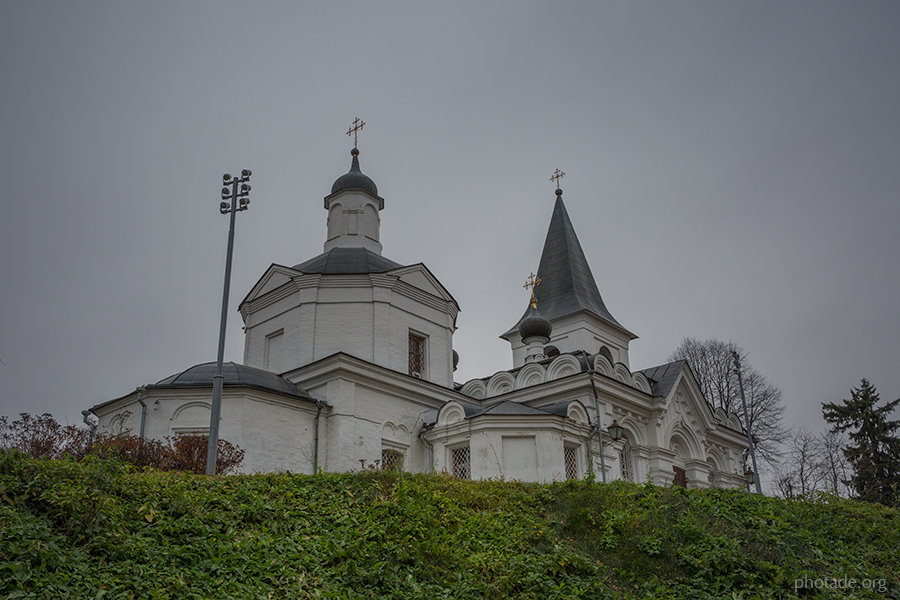
6. В Тарусе это самая старая церковь и самое старое здание,
памятник архитектуры 17 века (источник).
Этот же храм первым в Тарусе отдали верующим, когда православие вновь
вернулось в эти края (и было это в 1988 году). Кому
интересно, советую почитать подробную историю данного храма
здесь. The
oldest church and the oldest building of Tarusa, an architectural
monument of the 17th century (source).
This church was the first in Tarusa to be given back to the believers
when Orthodoxy returned to these parts again (and it was in 1988). For
those interested, I recommend reading the detailed history of this
church
here.
|
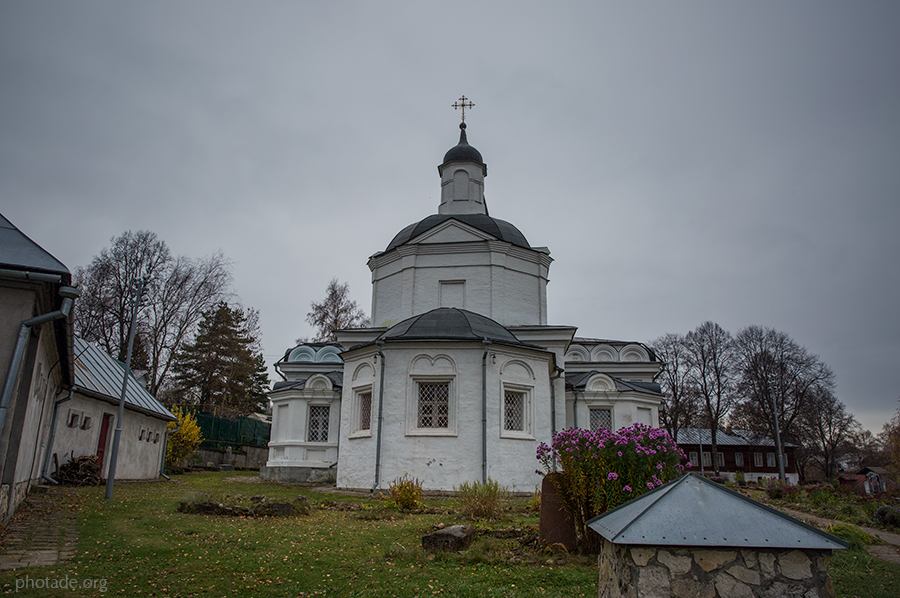 7. Вид на храм со стороны Оки, на переднем плане ― апсида с алтарём. С этой стороны хорошо видно, что храм представляет собой восьмерик на четверике. Территория храма хорошо ухожена, хотя в будни он закрыт. Открывается только на время служб, поэтому посетить этот храм нам не удалось. Впрочем, внутренне убранство храма можно посмотреть здесь. View of the church from the Oka side; in the foreground is the apse with the altar. From this side you can clearly see that the church is an octagon on a quadruple. The territory of the church is well maintained, although on weekdays it is closed. It opens only during services, so we did not visit this church. However, the interior decoration of this church can be seen here. |
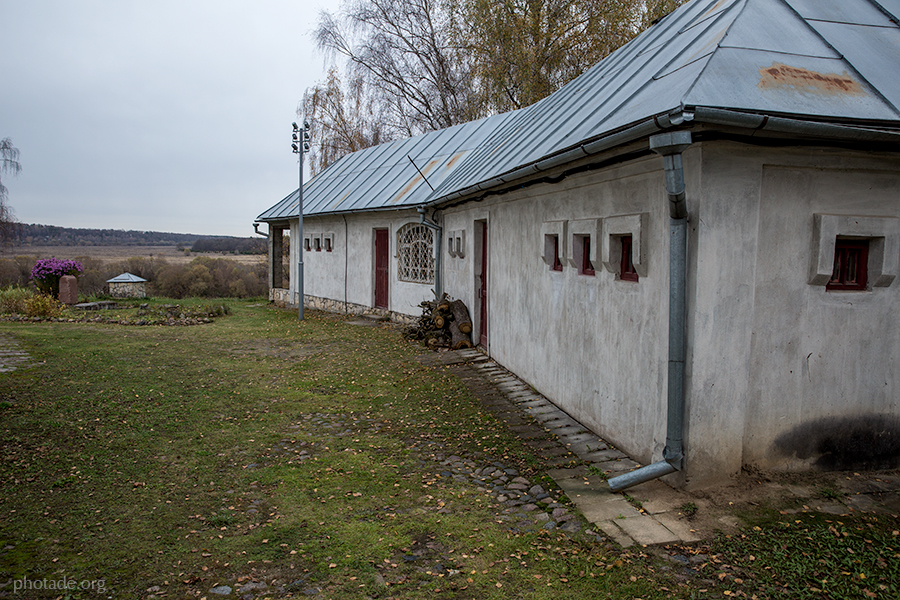
8. Прихрамовые строения на территории
церкви. За ярко-розовым кустом слева видно противоположный берег
Оки с Тульской областью. Здесь же на территории храма существует
Воскресная школа (источник).
Интересно, что когда-то здесь был мужской монастырь в честь святителя
Петра, митрополита московского (появился в середине 16 века). В
Тарусском уезде было два монастыря, второй ― Свято-Троицкая
женская община (источник),
«в 17 верстах» от Тарусы (или около 18 км).
Сейчас в Тарусском районе монастырей нет.
Church outbuildings on the territory of the church. Behind the bright
pink bush on the left, the opposite bank of the Oka with Tula Oblast is
visible. There is also a Sunday school on the church grounds here (source).
Interestingly, there was once a men's monastery here in honor of St.
Peter, Metropolitan of Moscow (it appeared in the mid-16th century). In
Tarussky Uyezd there were two monasteries; the second was the Holy
Trinity women's community (source),
"17 versts" from Tarusa (or about 18 km). Now there are no monasteries
in Tarussky District. |
|
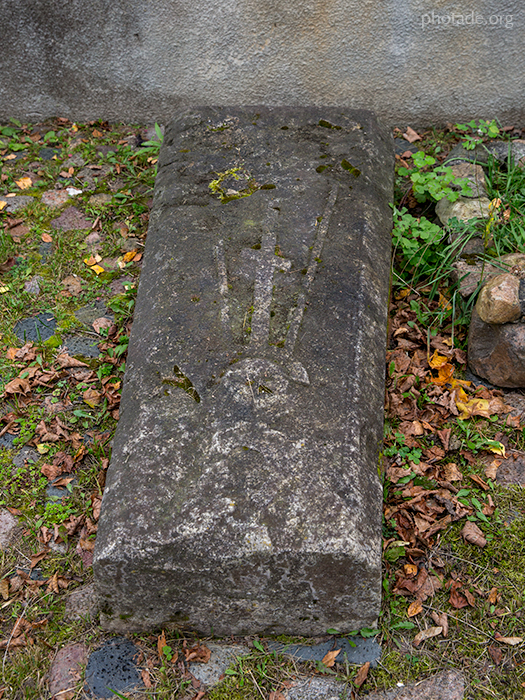
9. Надгробие с изображением Голгофского (схимнического) креста. Такие надгробия делали с 18 по самое начало 20 века, так что это камень от старой могилы. На территории церкви когда-то было кладбище, но надгробий сохранилось совсем немного ― это одно из них, но имена усопших уже канули в Лету. A tombstone with the image of the Golgotha cross. Such tombstones were made from the 18th to the very beginning of the 20th century, so this is a stone from an old grave. The church territory once had a cemetery, but very few tombstones have survived — this is one of them, but the names of the deceased have already sunk into oblivion. |
|
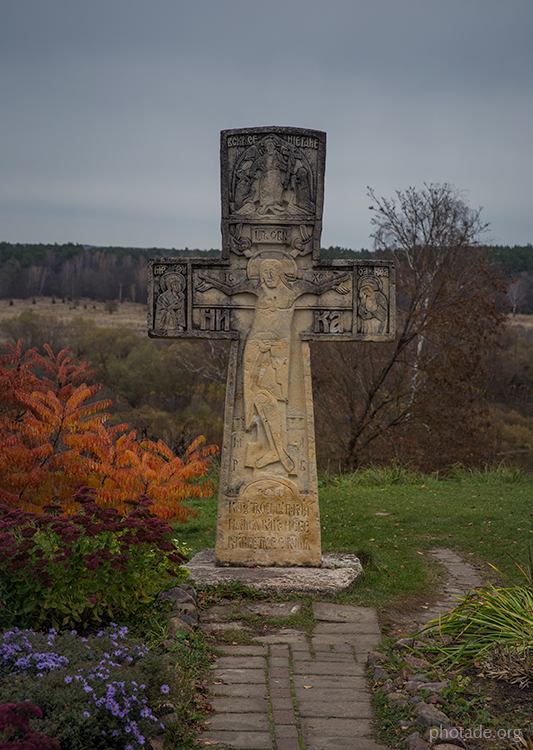
10. Поклонный крест, установленный в 1997 году в память православных христиан, похороненных на несохранившемся кладбище у храма, а также принимавших участие в воссоздании храма, но не доживших до его завершения (источник). Автор тот же, что и у каменного иконостаса в Петропавловском соборе: Анатолий Комелин. A worship cross installed in 1997 in memory of Orthodox Christians buried in the non-surviving cemetery near the church, as well as those who took part in the reconstruction of the church but did not live to see its completion (source). The author is the same as that of the stone iconostasis in the Cathedral of Peter and Paul: Anatoly Komelin. |
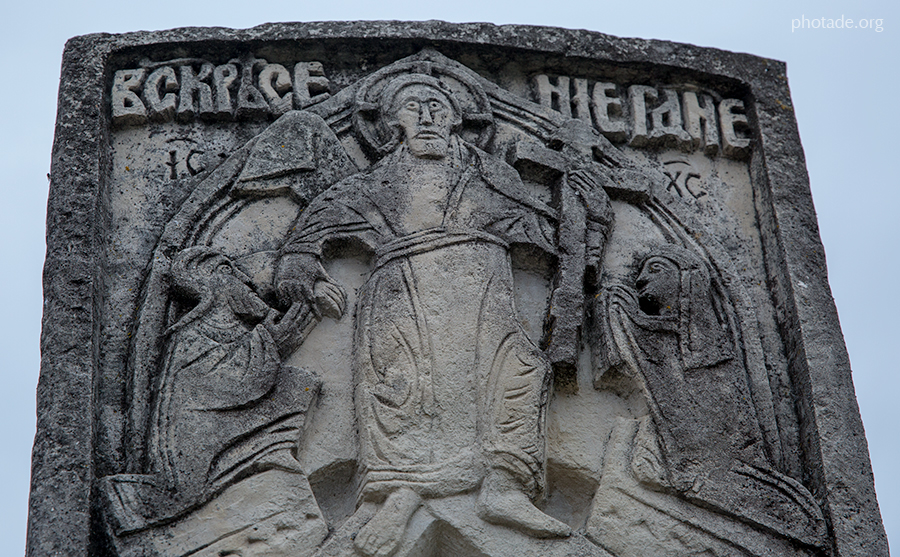 11. Навершие креста изображает Воскресение Господне. Согласно каноническим описаниям, здесь Иисус выводит из ада Адама, первого человека на Земле. Справа, соответственно, изображена Ева. Перекрещенные обломки под ногами Иисуса ― это врата ада (источник). The top of the cross depicts the Resurrection of the Lord. According to canonical descriptions, here Jesus is leading Adam, the first man on Earth, out of hell. On the right, accordingly, Eve is depicted. The crossed fragments under Jesus's feet are the gates of hell (source). |
|
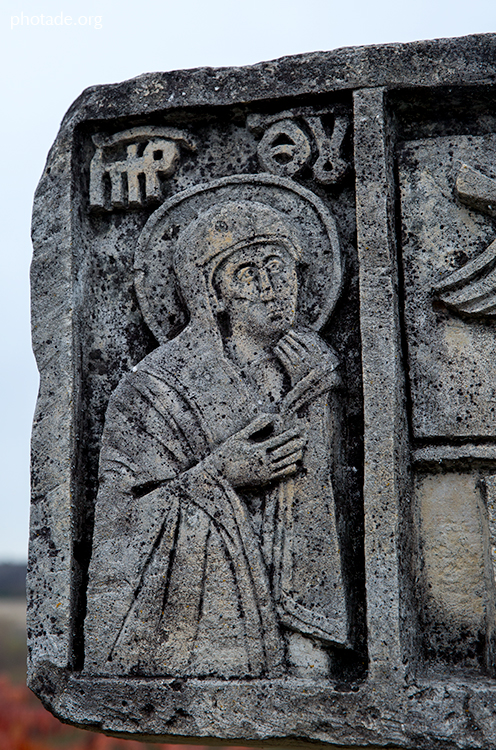
12. Изображение Девы Марии на правом плече Креста. Здесь похоже на изображение Богоматери-Агиосоритиссы (заступницы), но руки не совсем канонично расположены, и выражение лица... странное)) Вообще стиль автора представляет собой архаическую простоту в сочетании с традициями древнерусской резьбы. Образы слишком читаемы. Но порой говорят они не совсем о том, о чём хотел сказать автор. The image of the Virgin Mary on the right arm of the Cross. Here it resembles the image of the Mother of God Agiosoritissa, but the hands are not placed quite canonically, and the facial expression... is strange)) In general, the author's style represents an archaic simplicity combined with the traditions of Old Russian carving. The images are too readable. But sometimes they speak not quite about what the author wanted to say. |
|
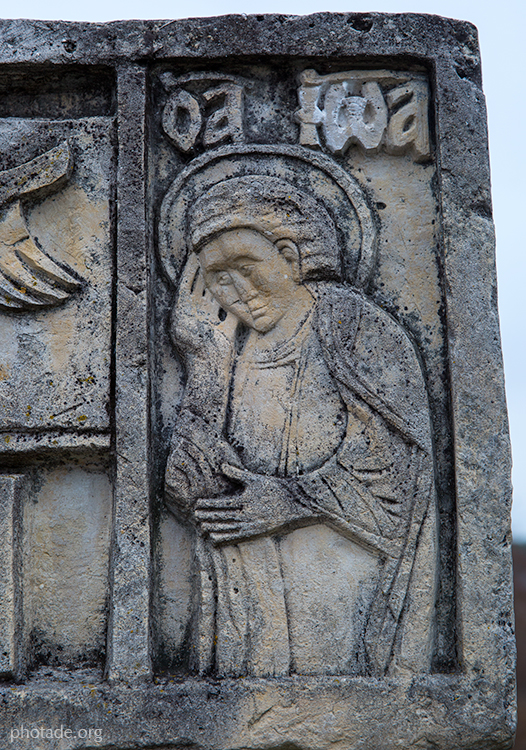
13. На левом плече Креста изображен Иоанн Богослов, любимый ученик Христа. В печали, как и положено по канону. On the left arm of the Cross is depicted John the Theologian, the beloved disciple of Christ. In sorrow, as is prescribed by the canon. |
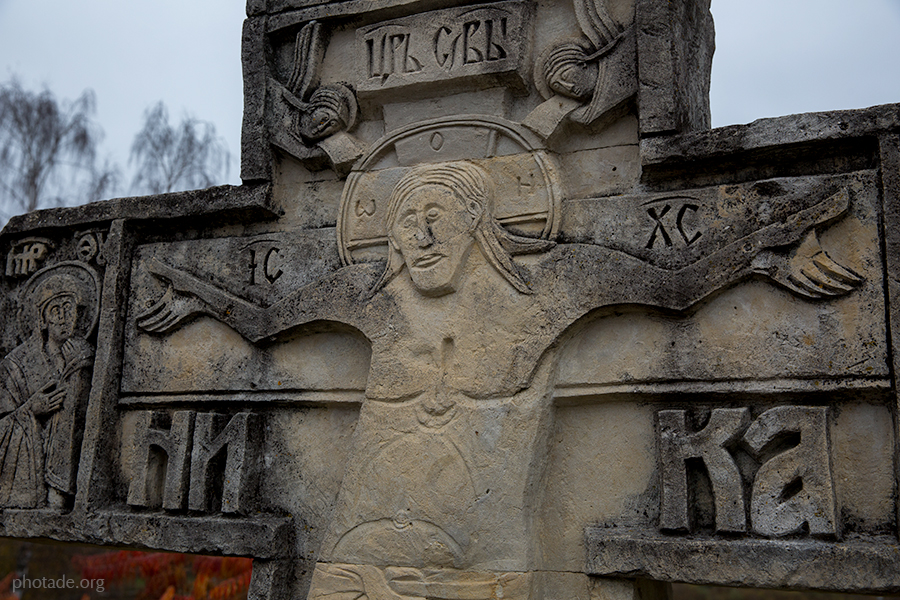 14. Христос на Кресте. Слово «НИКА» (разделенное на два слога) является каноническим для изображения Голгофского креста, переводится как «победа». Это слово находится в связке с именем Иисуса, присутствующем также на Кресте, обозначает, что Христос одержал победу над смертью, адом и Сатаной. А мне это изображение напоминает один известный мем, о котором я, впрочем, промолчу. Стиль изображения, конечно, фантастический... Christ on the Cross. The word "NIKA" (divided into two syllables) is canonical for the depiction of the Golgotha cross and is translated as "victory". This word is linked with the name of Jesus, also present on the Cross, and signifies that Christ won victory over death, hell and Satan. And this image reminds me of a well-known meme, which, however, I will keep quiet about. The style of the image is, of course, fantastic... |
|
Часовня Боголюбской иконы Божией Матери Chapel of the Bogolyubsky Icon of the Mother of God |
|
15. Часовня открыта в 2006 году, освящена в 2009 (источник). Здание стилизовано под русское средневековье. Для Тарусы это необычно: маленькая часовня сочетает в себе новгородскую фундаментальность с вдадимиро-суздальскими орнаментами. Часовня построена на пожертвования (источник). Архитектор ― Александр Любешкин, который также восстанавливал Петропавловский собор. Это пример того, что сейчас могут строить, как раньше: часовня производит впечатление абсолютно древней (не по качеству исполнения и сохранности, с этим всё в порядке а именно своей формой). Кстати, есть свидетельства, что раньше здесь тоже стояла часовня, а рядом недавно нашли старинное подземелье (источник). The chapel was opened in 2006 and consecrated in 2009 (source). The building is stylized as Russian medieval. For Tarusa this is unusual: the small chapel combines Novgorod solidity with Vladimir-Suzdal ornaments. The chapel was built on donations (source). The architect is Alexander Lyubeshkin, who also restored the Cathedral of Peter and Paul. This is an example of what can now be built as in the old days: the chapel gives the impression of being absolutely ancient — not in terms of the quality of execution and preservation, those are fine, but precisely by its form. By the way, there is evidence that a chapel also stood here before, and recently an ancient underground tonnel was found nearby (source).
|
|
16. Часовня находится в Игумновом овраге, рядом ― святой источник. Родник здесь известен ещё с 1650-х годов. Говорят, что он был освящен ещё в 1654 году патриархом Антиохийским (источник, источник). В 1848 году отсюда начался крестный ход с иконой Божьей Матери Боголюбской, спасшей город от холеры. Как пишет Википедия, Игумновым овраг назван Мариной Цветаевой, но других подтверждений этому факту я не нашла, а рядом ведь когда-то был Петровский монастырь, поэтому не факт, что до Цветаевой овраг так не назывался. До рубежа 1950-1960х родник был основным источником питьевой воды в городе. Источник святой, почитается до сих пор, а в советское время именно сюда приходили на Крещение, так как все церкви в городе были закрыты. The chapel is located in the Igumnov ravine, and next to it is a holy spring. The spring here has been known since the 1650s. They say that it was consecrated in 1654 by the Patriarch of Antioch (source, source). In 1848, a religious procession with the Bogolyubskaya Icon of the Mother of God, which saved the town from cholera, began from here. As Wikipedia writes, the ravine was named Igumnov by Marina Tsvetaeva, but I have not found other confirmations of this fact, and after all, the Petrovsky Monastery was once located nearby, so it is not a fact that the ravine was not called that before Tsvetaeva. Until the turn of the 1950s–1960s, the spring was the main source of drinking water in the town. The spring is holy, it is revered to this day, and in Soviet times it was precisely here that people came at Epiphany, since all the churches in the town were closed. |